Reactions of the Halide Ions (Cambridge International AS Chemistry)
Halide Ions: Reducing Agents
- Halide ions can also act as reducing agents and donate electrons to another atom
- The halide ions themselves get oxidised and lose electrons
- The reducing power of the halide ions increases going down the group
- This trend can be explained by looking at the ionic radii of the halides’ ions
The ionic radii of the halide ions
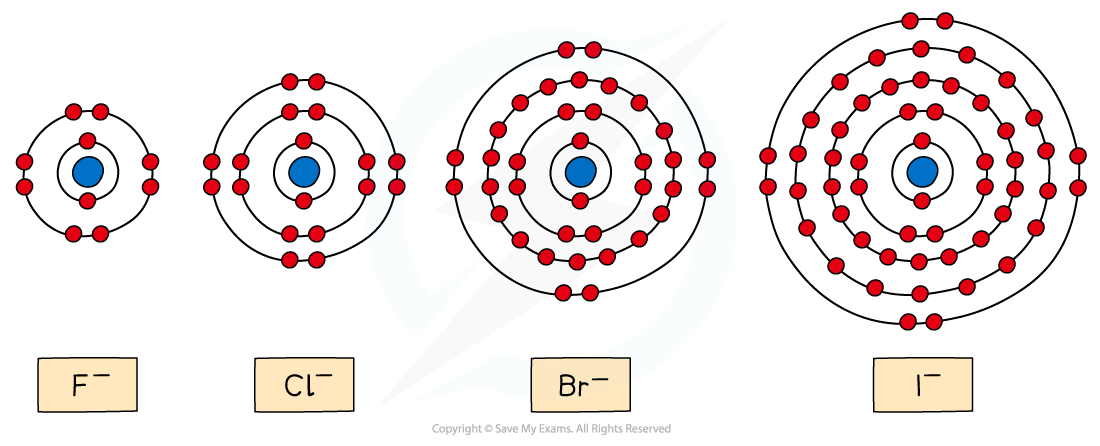
The diagram shows that going down the group the ionic radii of the halogens increases
- Going down the group, the halide ions become larger
- The outermost electrons get further away from the nucleus
- The outermost electrons also experience more shielding by inner electrons
- As a result of this, the outermost electrons are held less tightly to the positively charged nucleus
- Therefore, the halide ions lose electrons more easily going down the group and their reducing power increases
Linking the ionic radius to the reducing power of the halide ions
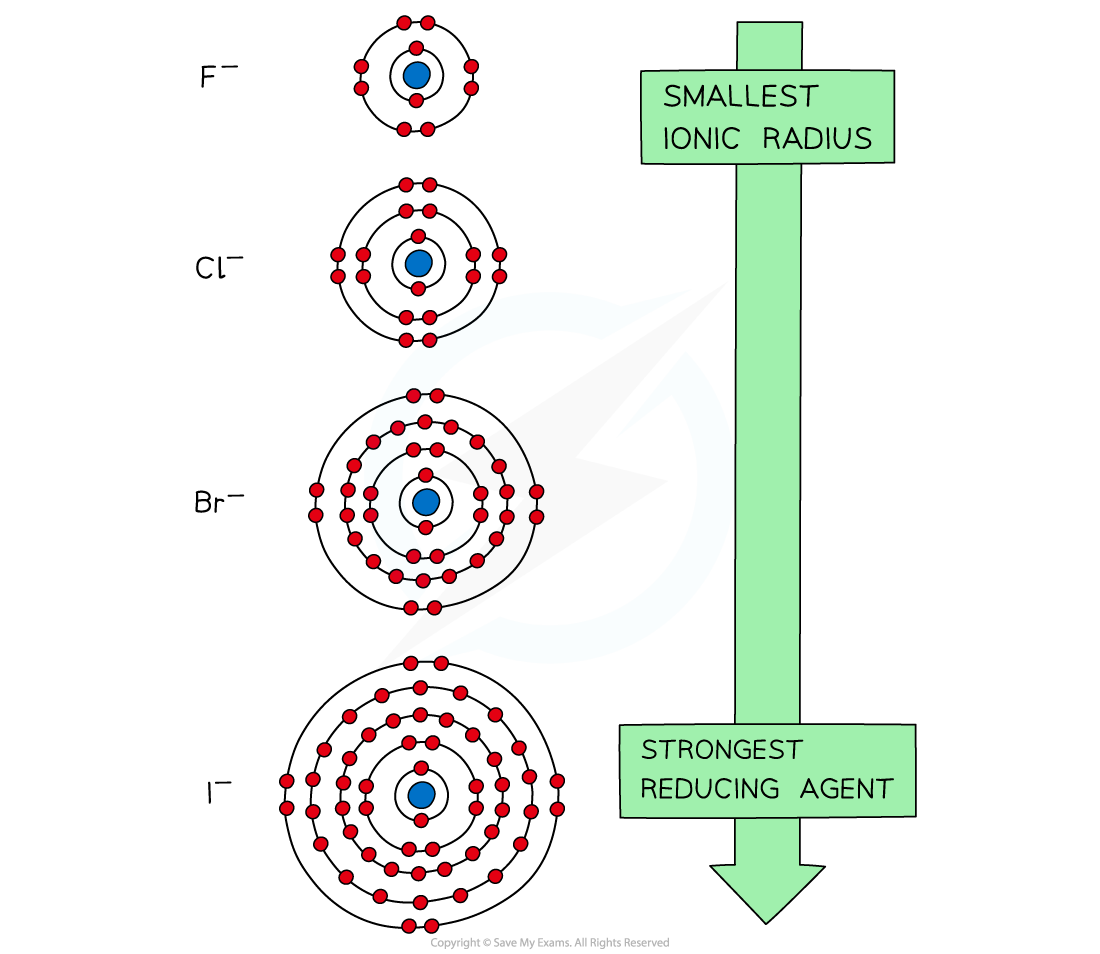
The reducing power of the halide ions increases going down the group
Exam Hint The ionic radius is a measure of the size of an atom’s ion
Reactions of Halide Ions
Spec point —
11.3.2
Silver ions & ammonia
- Halide ions can be identified in an unknown solution by dissolving the solution in nitric acid and then adding a silver nitrate solution followed by ammonia solution
- The halide ions will react with the silver nitrate solution as follows:
General equation: AgNO3 (aq) + X– (aq) → AgX (s) + NO3–****(aq)
Ionic equation: Ag+ (aq) + X– (aq) → AgX (s)
- X- is the halide ion in both equations
- If the unknown solution contains halide ions, then a precipitate of the silver halide will be formed (AgX)
Testing for halide ions
- Add the halide solution to a clean test tube using a pipette
- Add a few drops of nitric acid
- Add a few drops of silver nitrate solution
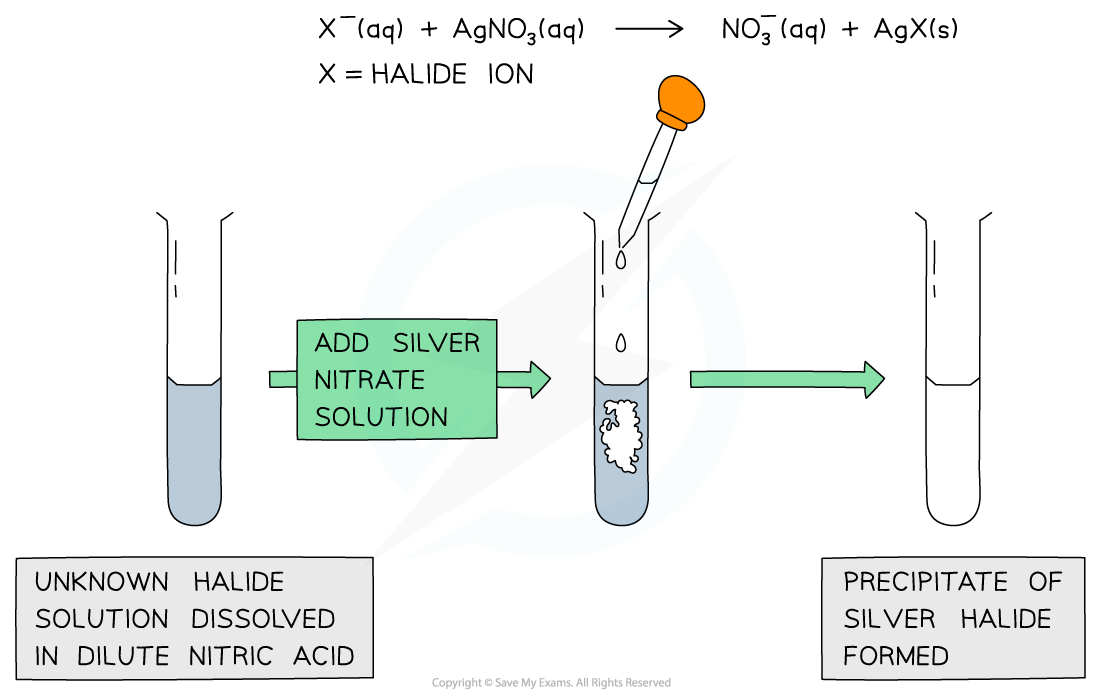
A silver halide precipitate is formed upon the addition of silver nitrate solution to halide ion solution
- Observe the formation of a coloured precipitate:
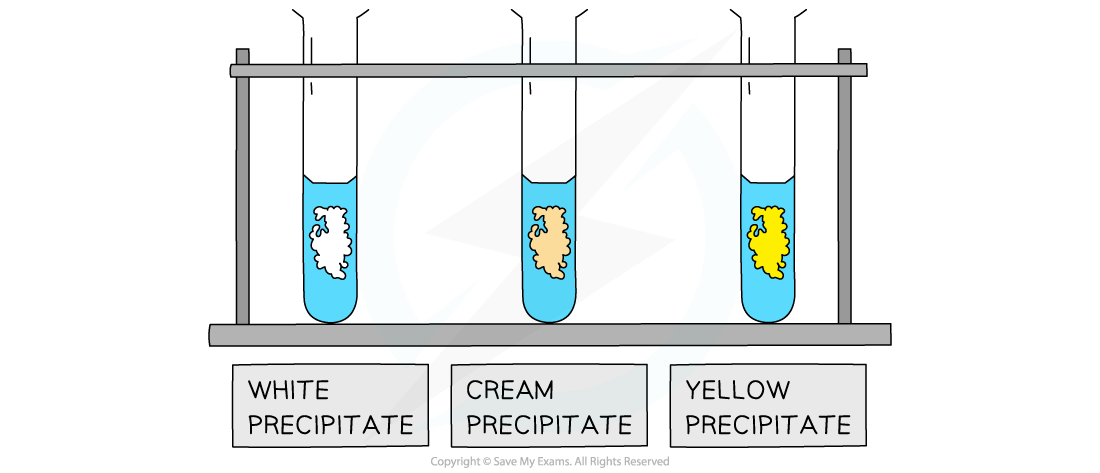
The white, cream and yellow precipitates formed when halide ions react with silver nitrate solution
-
Each precipitate is associated with a specific halide ion:
- A white precipitate of AgCl forms if chloride ions are present
- A cream precipitate of AgBr forms if bromide ions are present
- A yellow precipitate of AgI forms if iodide ions are present
Adding ammonia after the halide ion test
- The silver halide precipitates can look similar
- So, an additional test using ammonia solution can confirm their identity
- Add dilute ammonia solution dropwise to the silver halide precipitate
- If the precipitate dissolves, the halide is chloride (AgCl)
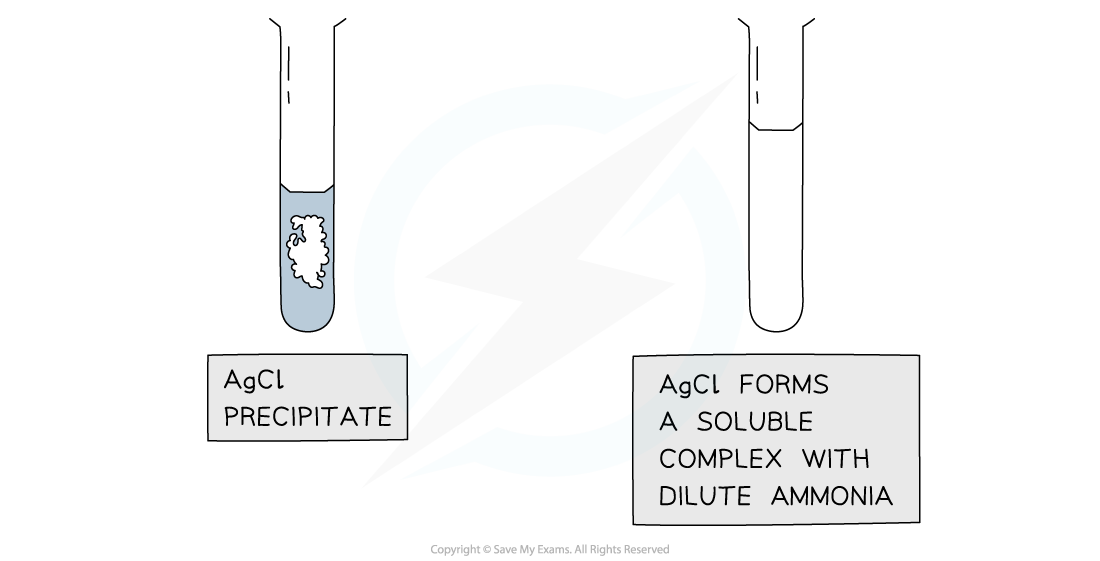
- If the precipitate does not dissolve, add concentrated ammonia
- If the precipitate now dissolves, the halide is bromide (AgBr)
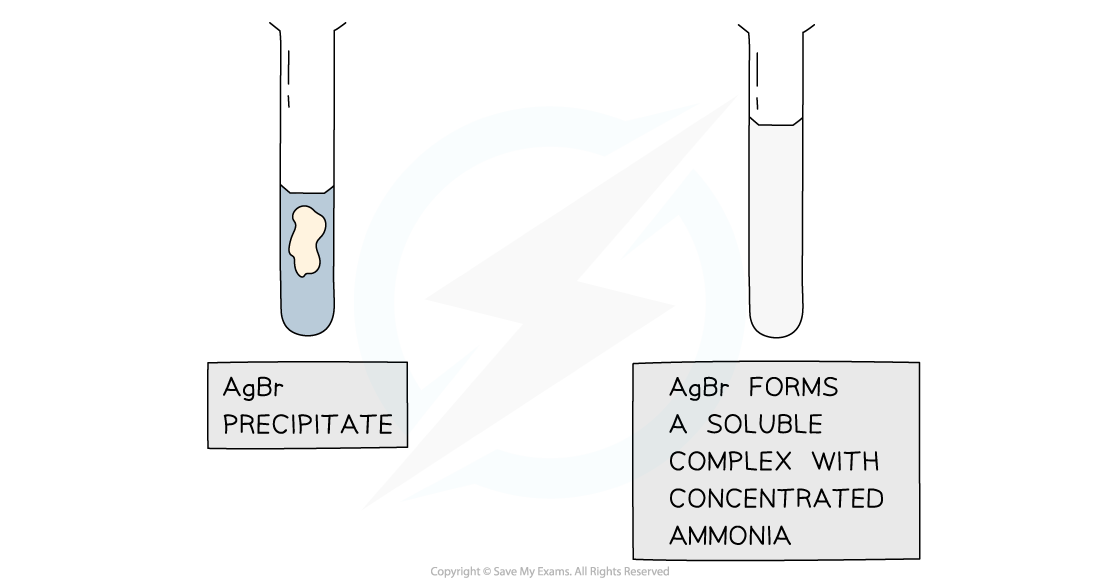
- If the precipitate still does not dissolve, the halide is iodide (AgI)
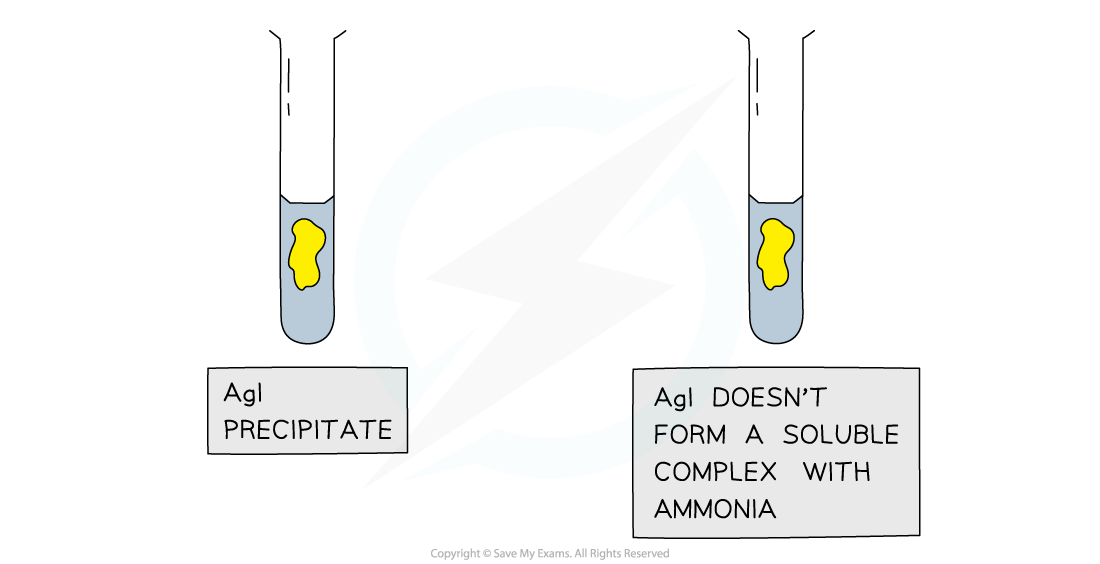
Reaction of halide ions with silver nitrate & ammonia solutions table
| Halide ion | Colour of silver halide precipitate | Effect of adding dilute ammonia solution to the precipitate | Effect of adding concentrated ammonia solution to the precipitate |
|---|---|---|---|
| Cl–(aq) | White | Dissolves | Dissolves |
| Br–(aq) | Cream | Insoluble | Dissolves |
| I–(aq) | Yellow | Insoluble | Insoluble |
Concentrated sulfuric acid
- Chloride, bromide and iodide ions react with concentrated sulfuric acid to produce toxic gases
- These reactions should therefore be carried out in a fume cupboard
- The general reaction of the halide ions with concentrated sulfuric acid is:
General equation: H2SO4 (aq) + X– (aq) → HX (g) + HSO4– (aq)
- Where X– is the halide ion
Reaction of chloride ions with concentrated sulfuric acid
-
Concentrated sulfuric acid is dropwise added to sodium chloride crystals to produce hydrogen chloride gas
- The hydrogen chloride gas produced is wet, so it can be passed through a conical flask of concentrated sulfuric acid to produce dry hydrogen chloride gas
Apparatus for the reaction of sodium chloride with concentrated sulfuric acid
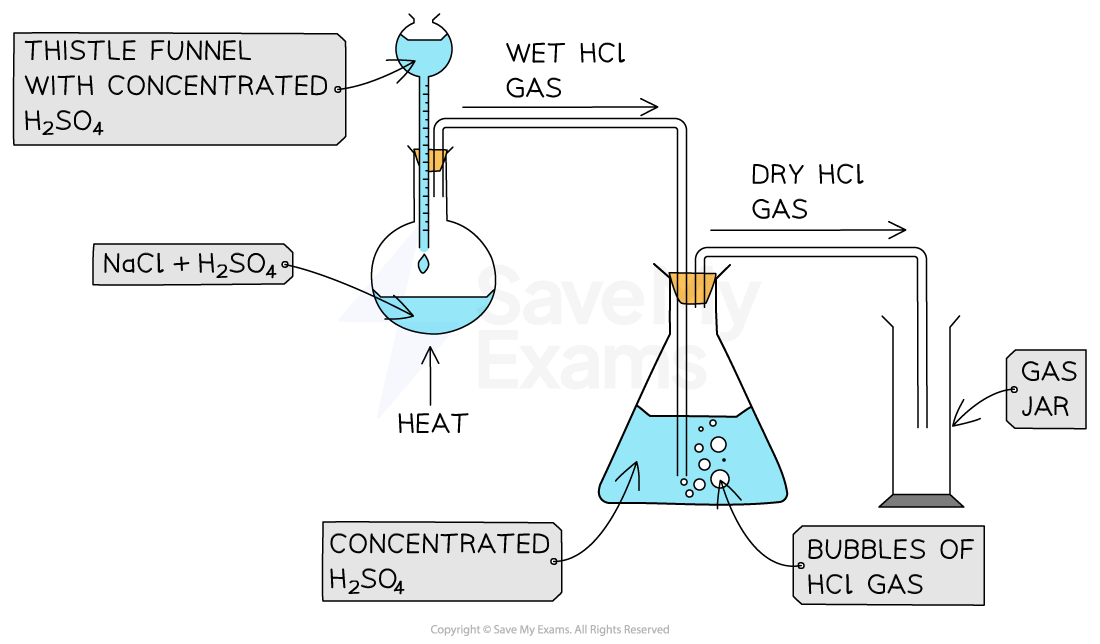
Sodium chloride reacts with concentrated sulfuric acid to form dense hydrogen chloride gas
- The reaction that takes place is:
H2SO4 (aq) + NaCl (s) → HCl (g) + NaHSO4 (s)
- The HCl gas produced is seen as white fumes
Reaction of bromide ions with concentrated sulfuric acid
- The thermal stability of the hydrogen halides decreases down the group
- The reaction of sodium bromide and concentrated sulfuric acid is:
H2SO4 (aq) + NaBr (s) → HBr (g) + NaHSO4 (s)
- The concentrated sulfuric acid oxidises HBr to bromine, and the sulfuric acid itself is reduced to sulfur dioxide gas (water is also formed):
2HBr (g) + H2SO4 (aq) → Br2 (g) + SO2 (g) + 2H2O (l)
- The bromine is seen as a reddish-brown gas
Reaction of iodide ions with concentrated sulfuric acid
- The reaction of sodium iodide and concentrated sulfuric acid is:
H2SO4 (aq) + NaI (s) → HI (g) + NaHSO4 (s)
- Hydrogen iodide decomposes the easiest
- Sulfuric acid oxidises the hydrogen iodide to several extents:
- The concentrated sulfuric acid oxidises HI and is itself reduced to sulfur dioxide gas:
2HI (g) + H2SO4 (aq) → I2 (g) + SO2 (g) + 2H2O (l)
- Iodine is seen as a violet/purple vapour
- The concentrated sulfuric acid oxidises HI and is itself reduced to sulfur:
6HI (g) + H2SO4 (aq) → 3I2 (g) + S (s) + 4H2O (l)
- Sulfur is seen as a yellow solid
- The concentrated sulfuric acid oxidises HI and is itself reduced to hydrogen sulfide:
8HI (g) + H2SO4 (aq) → 4I2 (g) + H2S (g) + 4H2O (l)
- Hydrogen sulfide has a strong smell of bad eggs
Halide ion reactions with concentrated sulfuric acid table
| Halide ion | Reaction with concentrated sulfuric acid | Observations |
|---|---|---|
| Cl–(aq) | H2SO4 (aq) + NaCl (s) → HCl (g) + NaHSO4 (aq) | White fumes of HCl gas |
| Br–(aq) | H2SO4 (aq) + NaBr (s) → HBr (g) + NaHSO4 (s) 2HBr (g) + H2SO4 (aq) → Br2 (g) + SO2 (g) + 2H2O (l) | Reddish brown Br2 gas |
| I–(aq) | H2SO4 (aq) + NaI (s) → HI (g) + NaHSO4 (s) H2SO4 (aq) + 2HI (g) → I2 (g) + SO2 (g) + 2H2O (l) H2SO4 (aq) + 6HI (g) → 3I2 (g) + S (s) + 4H2O (l) H2SO4 (aq) + 8HI (g) → 4I2 (g) + H2S (g) + 4H2O (l) | Violet / purple I2 vapour Yellow solid of S Strong, bad (egg) smell of H2S |
Exam Hint It gets easier to oxidise the hydrogen halides as you descend Group 17: the halides become stronger reducing agents
Was this revision note helpful?