Bond Polarity & Dipole Moments (Cambridge International AS Chemistry)
Spec point —
3.6.2
Bond Polarity & Dipole Moments
- Electronegativity is the ability of an atom to draw a pair of electrons towards itself in a covalent bond
- Electronegativity increases across a Period and decreases going down a Group
Polarity
- When two atoms in a covalent bond have the same electronegativity the covalent bond is nonpolar
Bonding electrons in a chlorine molecule
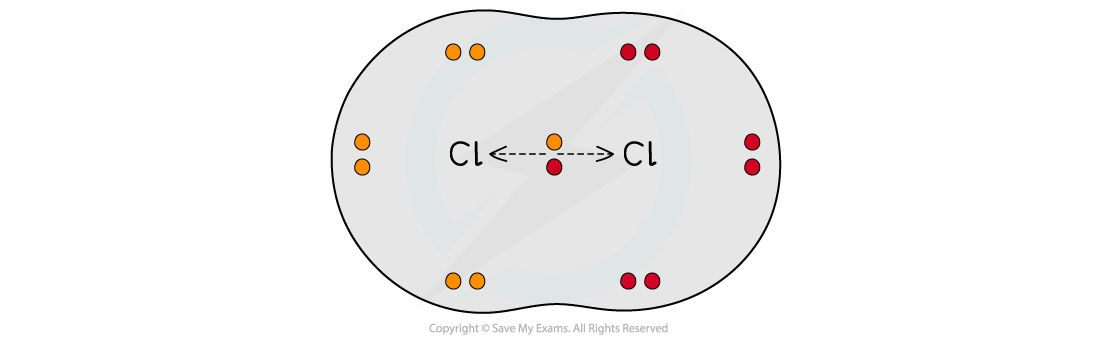
The two chlorine atoms have the same electronegativity so the bonding electrons are shared equally between the two atoms
-
When two atoms in a covalent bond have different electronegativities the covalent bond is polar and the electrons will be drawn towards the more electronegative atom
-
As a result of this:
- The negative charge centre and positive charge centre do not coincide with each other
- This means that the electron distribution is asymmetric
- The less electronegative atom gets a partial charge of δ+ (delta positive)
- The more electronegative atom gets a partial charge of δ- (delta negative)
-
The greater the difference in electronegativity the more polar the bond becomes
Bonding electrons in a hydrogen chloride molecule
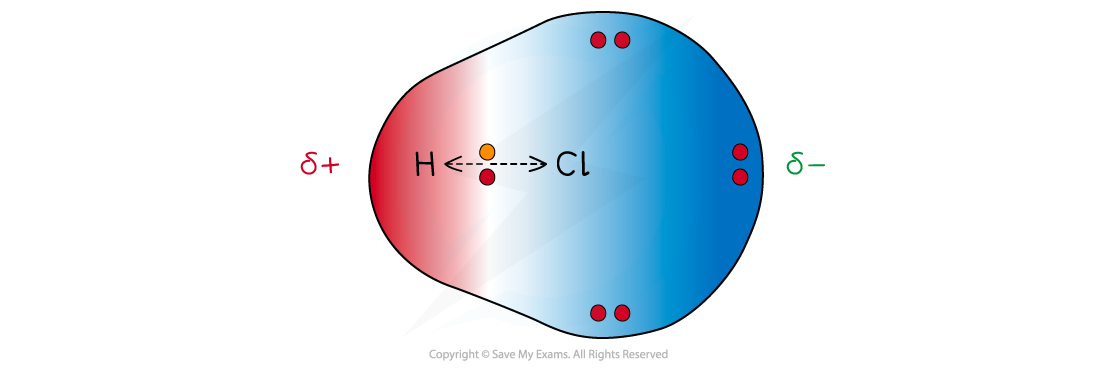
Cl has a greater electronegativity than H causing the electrons to be more attracted towards the Cl atom which becomes delta negative and the H delta positive
Dipole moment
- The dipole moment is a measure of how polar a bond is
- The direction of the dipole moment is shown by a sign made of an arrow with a short cross at its tail: the cross is at the partially positively charged end (δ+) and the arrow points to the partially negatively charged end(δ-) of the dipole
Representing dipoles

The sign shows the direction of the dipole moment and the arrow points to the delta negative end of the dipole
Assigning polarity to molecules
-
To determine whether a molecule with more than two atoms is polar, the following things have to be taken into consideration:
- The polarity of each bond
- How the bonds are arranged in the molecule
-
Some molecules have polar bonds but are overall not polar because the polar bonds in the molecule are arranged in such a way that the individual dipole moments cancel each other out
Polarity in chloromethane
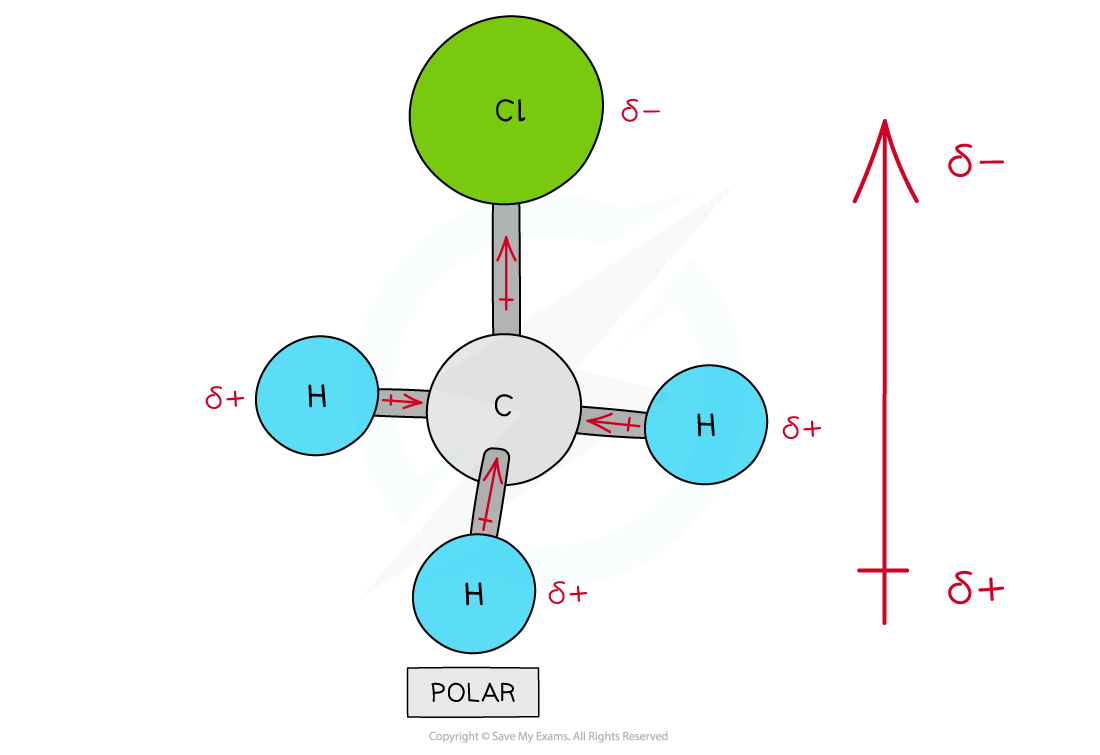
There are four polar covalent bonds in CH3Cl which do not cancel each other out causing CH3Cl to be a polar molecule; the overall dipole is towards the electronegative chlorine atom
Polarity in tetrachloromethane
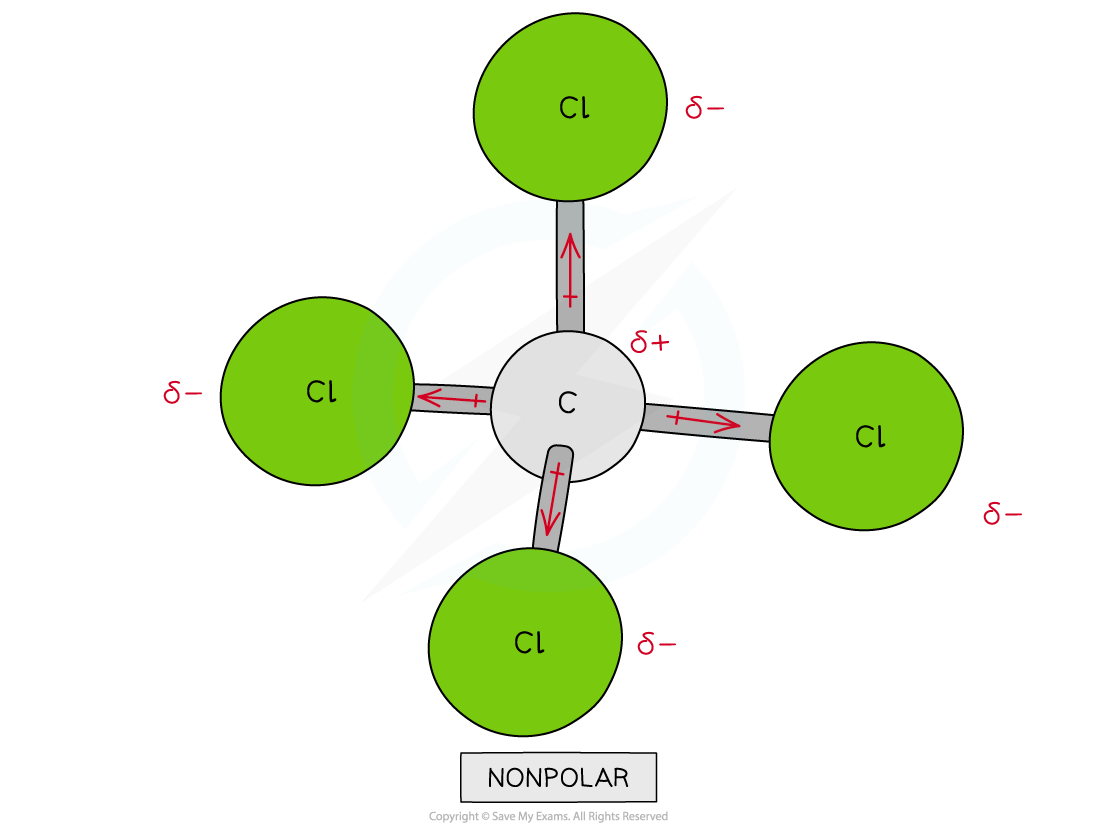
Though CCl4 has four polar covalent bonds, the individual dipole moments cancel each other out causing CCl4 to be a nonpolar molecule
Was this revision note helpful?