18 markseasy
(i) Differentiate
(ii) Use the product rule to differentiate
(iii) Use the quotient rule to differentiate
(iv) Use the chain rule to differentiate
35 questions · 193 marks · ≈ 3 hours
(i) Differentiate
(ii) Use the product rule to differentiate
(iii) Use the quotient rule to differentiate
(iv) Use the chain rule to differentiate
A curve has equation .
Find an expression for .
(i) Find the gradient of the tangent at the point where , giving your answer in the form , where is a positive integer to be found.
(ii) Hence show that the gradient of the normal to the curve at the point where is .
Find for
(i) y = \text{sin}\left(3x^{2}\right)
(ii) y = 2\text{ln}\left(x^{3}\right)
The curve with equation passes through the point .
(i) Find an expression for .
(ii) Find the equation of the tangent to the curve at the point .
Differentiate \left(x^{3} - 2x\right)\text{ln} \; x with respect to .
Differentiate with respect to .
Differentiate with respect to .
Differentiate with respect to .
Write down when
(i)
(ii)
The function is defined as
\text{f}(x) = \left(x^{2} - 4x + 4\right)\text{ln} \; x, \quad x > 0
Show that the graph of meets the -axis at the points and .
Find .
Find the gradient of the tangent at the point .
Hence find the equation of the tangent at the point , giving your answer in the form , where , and are integers to be found.
Given that the derivative of is , use the chain rule to show that the derivative of is
where is a real constant.
Hence find the coordinates of the point(s) where the curve has a gradient of . Give the coordinates as exact values.
(i) Differentiate
(ii) Use the product rule to differentiate
(iii) Use the quotient rule to differentiate
(iv) Use the chain rule to differentiate \text{cos}\left(x^{2} - 7x + 1\right)
A curve has equation , .
Find the gradient of the normal to the curve at the point \left(1, \text{e}^{-3}\right), giving your answer correct to 3 decimal places.
Find for y = \text{cos}\left(x^{2} - 3x + 7\right) + \text{sin}\left(\text{e}^{x}\right).
Find for y = \text{ln}\left(2x^{3}\right).
Find the equation of the tangent to the curve at the point , giving your answer in the form , where , and are integers.
Differentiate with respect to , simplifying your answers as far as possible:
\left(4\text{cos} \; x - 3\text{sin} \; x\right)\text{e}^{3x - 5}
\left(x^{3} - 4x^{2} + 7\right)\text{ln} \; x
Differentiate with respect to .
Show that if , then
Hence find the gradient of the tangent to the curve at the point with coordinates \left(\dfrac{\pi}{3}, \dfrac{2\sqrt{3}}{3}\right).
The diagram below shows part of the graph of , where is the function defined by
\text{f}(x) = \left(x^{2} - 1\right)\text{ln}(x + 3), \quad x > -3
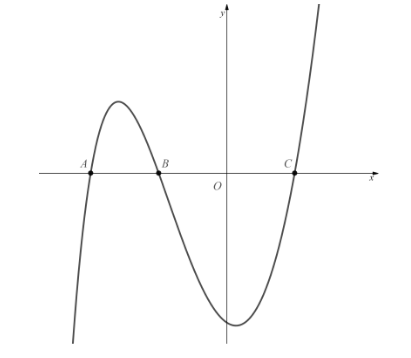
Points , and are the three places where the graph meets the -axis.
Find .
Show that the coordinates of point are .
Find the equation of the tangent to the curve at point .
Use the chain rule to differentiate , where is a real constant.
What does your answer to part (a) tell you about the number of stationary points on the curve ?
Use an appropriate method to differentiate each of the following.
(i)
(ii)
(iii)
(iv)
Find the gradient of the normal to the curve y = 5\text{cos}\left(\text{e}^{x} - \dfrac{\pi}{2}\right) at the point with -coordinate . Give your answer correct to 3 decimal places.
Differentiate \left(2\text{sin} \; 3x - \text{cos} \; 3x\right)\text{e}^{6 - x} with respect to , simplifying your answer as far as possible.
Differentiate \left(x^{2} - x\right)^{2}\text{ln} \; 5x with respect to , simplifying your answer as far as possible.
Use an appropriate method to differentiate each of the following.
(i)
(ii) \left(x^{2} + 2x - 8\right)\text{cos}(3 - x)
(iii)
(iv)
A curve has equation , .
Show that the equation of the tangent to the curve at the point with -coordinate is
y = \left(\dfrac{\text{e}^{3} - 3}{\text{e}^{3}}\right)x + \dfrac{4 - \text{e}^{3}}{\text{e}^{3}}
For y = \text{ln}\left(ax^{n}\right), where is a real number and is an integer, show that
By writing as y = \text{f}(x)\left[\text{g}(x)\right]^{-1} and then using the product and chain rules, show that
\dfrac{\text{d}y}{\text{d}x} = \dfrac{\text{g}(x)\text{f}'(x) - \text{f}(x)\text{g}'(x)}{\left(\text{g}(x)\right)^{2}}
Given that , find in terms of .
Hence find in terms of .
The diagram below shows part of the graph of , where is the function defined by
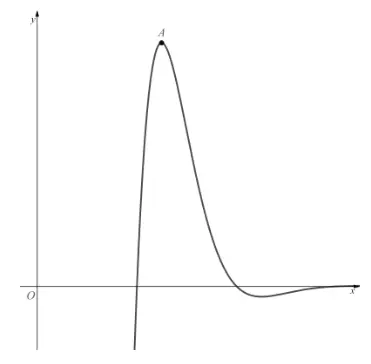
Point is a maximum point on the graph.
Show that the -coordinate of is a solution to the equation
\dfrac{\text{cos} \; x + \text{e}^{x}\left(\text{sin} \; x - \text{cos} \; x\right)}{\text{e}^{2x} - 2\text{e}^{x} + 1} = 0
Use the chain rule to show that the derivative of y = \text{tan}^{-1}\left(\dfrac{x}{a}\right), where is a real constant, is
Hence find the coordinates of any stationary point(s) on the curve with equation
y = -\dfrac{x}{4} + \text{tan}^{-1}\left(\dfrac{x}{2}\right)
giving your answers as exact values.
A curve has equation .
Show that the gradient of the normal to the curve at the point \left(1, \dfrac{7}{2}\right) is
Find the derivative of the function \text{f}(x) = \text{sin}\left(\text{cos}\left(\text{ln}\left(\dfrac{1}{x}\right)\right)\right), .
Show that the derivative of is
Hence find the equation of the tangent to the curve at the point \left(1, \dfrac{1}{4}\right), giving your answer in the form , where and are to be given as exact values.
Differentiate \left(5 + \text{sin}^{2} \; 3x\right)\text{e}^{x^{2} - 3x + 2} with respect to , simplifying your answer where possible.
Differentiate 3^{\sqrt{x}}\left(\sqrt{x} - \dfrac{1}{\sqrt{x}}\right) with respect to , simplifying your answer where possible.
The diagram below shows the graph of , where is the function defined by
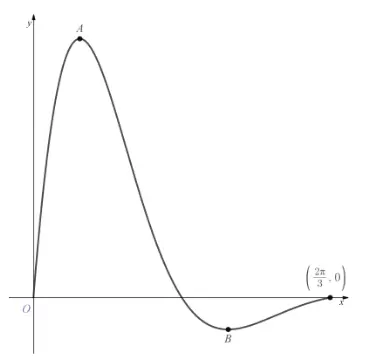
The points and are maximum and minimum points, respectively.
Find the range of , giving your answer correct to 3 decimal places.
A sequence of functions is defined by the recurrence relation
Based on that sequence, the function is defined by
\text{f}_{n}(x) = \sum_{r=1}^{n} u_{r}(x)
Calculate the value of \text{f}_{41}\left(\dfrac{\pi\sqrt{2}}{4}\right).
Use calculus to find the coordinates of the stationary points of the curve
y = \dfrac{x}{3} - \text{tan}^{-1}\left(\dfrac{2x}{3}\right)
and determine whether each one is a maximum or a minimum. The coordinates should be given as exact values.