Show that θ=18∘ satisfies the equation cos3θ=sin2θ. By expressing cos3θ and sin2θ in terms of trigonometrical functions of θ, show that sin18∘ is a root of the equation 4x2+2x−1=0, and hence find its value as a surd.
Find all solutions between 0∘ and 360∘ of the equation 4tan2x=cotx.
Suggestion
If cosα=sinβ, what can we say about α and β?
By expressing cos3θ and sin2θ in terms of trigonometrical functions of θ, show that sin18∘ is a root of the equation 4x2+2x−1=0...
How could we write cos3θ and sin2θ in terms of cosθ and sinθ? Could we say cos(3θ)=cos(2θ+θ)?
If you can write sin2θ−cos3θ=0 in terms of cosθ and sinθ, can you see anything that looks similar to 4x2+2x−1?
… and hence find its value as a surd.
How could we solve a quadratic equation to give an exact solution?
Can we write tan and cot in terms of cos and sin?
Can we learn from what we did for the first part?
Solution
We know that cos(3×18∘)=cos54∘=sin(90∘−54∘)=sin36∘=sin(2×18∘). So θ=18∘ satisfies cos3θ=sin2θ.
By expressing cos3θ and sin2θ in terms of trigonometrical functions of θ, show that sin18∘ is a root of the equation 4x2+2x−1=0, …
We can express both cos3θ and sin2θ in terms of just s=sinθ and c=cosθ.
We’ll use the identities sin2θ=2sc,cos2θ=1−2s2 and cos(α+β)=cosαcosβ−sinαsinβ.
We have cos3θ=cos(2θ+θ)=cos(2θ)c−sin(2θ)s=(1−2s2)c−2scs=c(1−4s2).
So if sin2θ−cos3θ=0, we have 2sc−c(1−4s2)=0, or c(4s2+2s−1)=0.
Now we know that sin(18∘) is a solution to this equation, and so sin(18∘) is a root of 4x2+2x−1=0, since cos18∘=0.
Hence find its value as a surd.
We complete the square in order to find the roots of 4x2+2x−1 in surd form. We have 4x2+2x−1=(2x+21)2−45=0, so that 2x+21=±25, and we have x=4−1±5. Finally, we must choose whether we need a plus or a minus sign to find the root corresponding to sin18∘. We know that sin18∘>0, so we choose the plus sign. So we have that sin18∘=4−1+5.
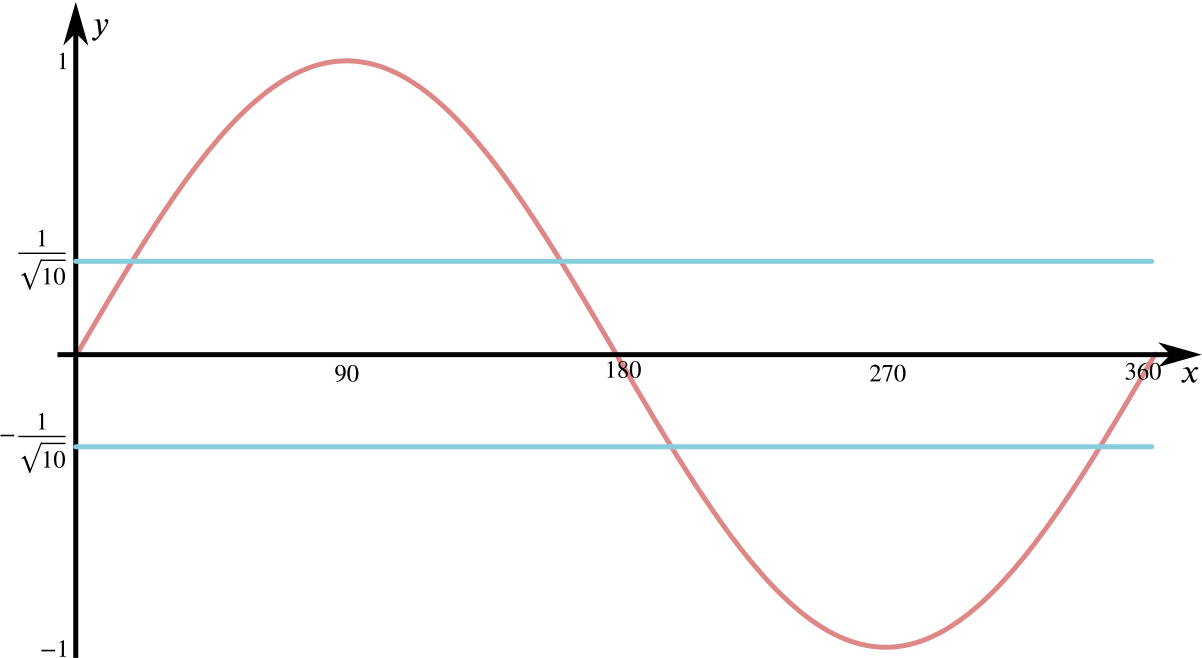
We play a similar game here to that of the first part of the question. Firstly, we can write tanx=cs,cotx=tanx1=sc, so the equation we need to solve becomes 4cos(2x)sin(2x)=sc⟹4sin(2x)s−cos(2x)c=0⟹8s2c−(1−2s2)c=0⟹(10s2−1)c=0. So we have that cosx=0 solves this, which gives us the values x=90∘,270∘ between 0∘ and 360∘. We also have that sinx=±101 is a solution, so that x=sin−1(±1/10) are also solutions. To work out how many solutions between 0∘ and 360∘, consider
We see that sinx=±1/10 four times between 0∘ and 360∘.
Using a calculator, one finds that sin−1(1/10)=18.4∘ to one decimal place. From the symmetries of sine, we see that the other angles are then 180∘−18.4∘=161.6∘, 180∘+18.4∘=198.4∘ and 360∘−18.4∘=341.6∘, giving us six solutions in total.