When does the trapezium rule give the exact answer here?
Question
[Choose the one correct answer and explain your reasoning.]
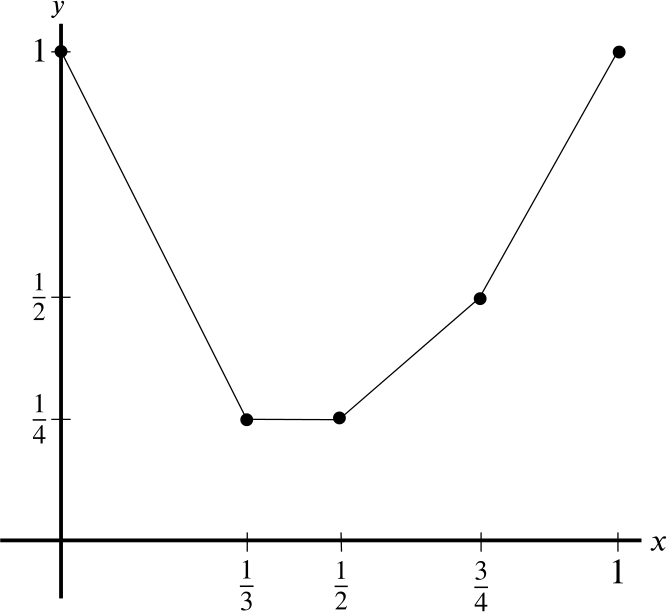
The graph of a function is drawn below for .
The trapezium rule is then used to estimate
by dividing into equal intervals. The estimate calculated will equal the actual integral when
- is a multiple of ;
- is a multiple of ;
- is a multiple of ;
- is a multiple of .
Suggestion
The notation means the area between the and the -axis, from to .
Solution
The function is linear on the intervals
and in order to use the trapezium rule, we need to divide the interval into equal intervals.
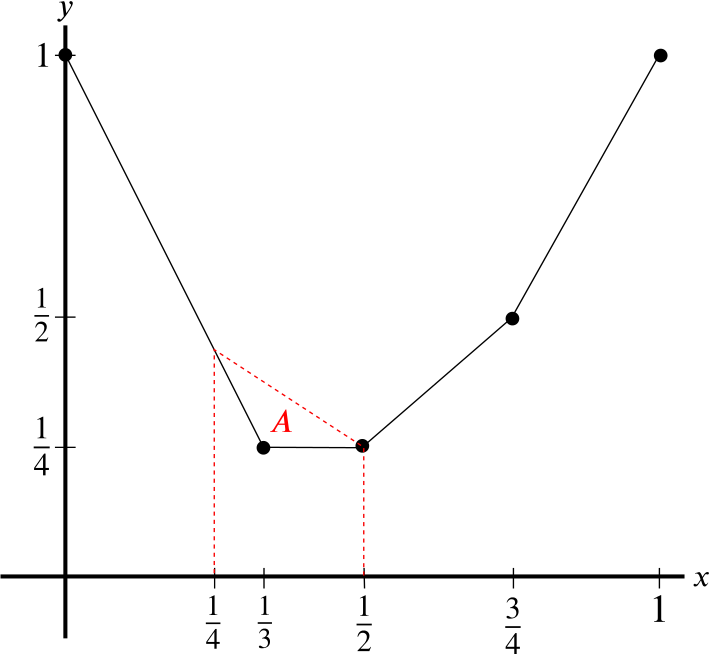
However, if the values aren’t at the end of an interval, then the trapezium rule will overestimate the value of the integral.
For example, if we took as one of the intervals (), then we would be overestimating the value of the integral, because we would also be including the area of triangle A, as shown below.
Therefore we need to choose a value of such that lie at the end of intervals.
The largest such interval would be of width , that is, , and similarly, can be any multiple of .
Hence the answer is (d).