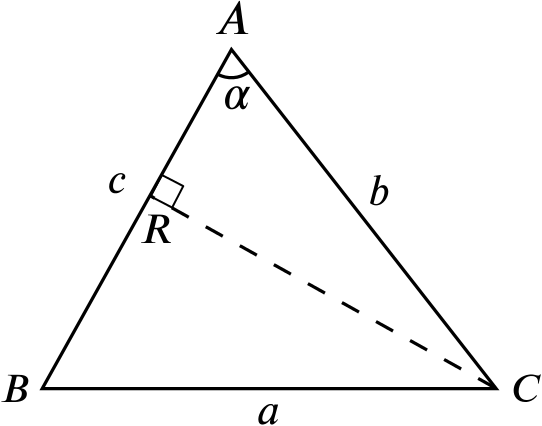
Can we find the area of a pedal triangle?
Question
A triangle ABC has sides BC, CA, and AB of lengths a, b and c respectively, and angles at A, B and C are α, β and γ where 0≤α,β,γ≤21π.
- Show that the area of ABC equals 21bcsinα. Deduce the sine rule sinαa=sinβb=sinγc.
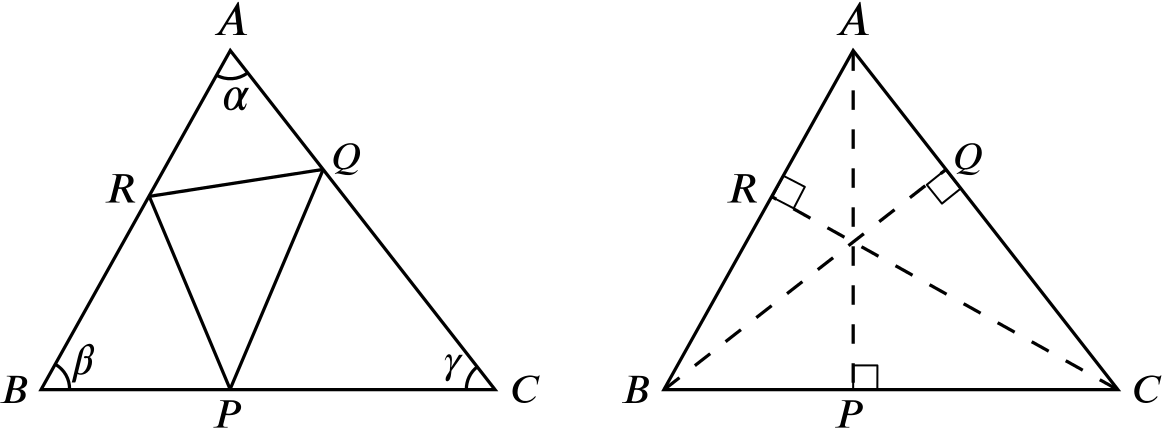
- The points P, Q and R are respectively the feet of the perpendiculars from A to BC, B to CA, and C to AB as shown. Prove that Area of PQR=(1−cos2α−cos2β−cos2γ)×(Area of ABC).
- For what triangles ABC, with angles α, β, γ as above, does the equation cos2α+cos2β+cos2γ=1 hold?
Suggestion
A triangle ABC has sides BC, CA, and AB of lengths a, b and c respectively, and angles at A, B and C are α, β and γ where 0≤α,β,γ≤21π.
…
- The points P, Q and R are respectively the feet of the perpendiculars from A to BC, B to CA, and C to AB as shown. Prove that Area of PQR=(1−cos2α−cos2β−cos2γ)×(Area of ABC).
- For what triangles ABC, with angles α, β, γ as above, does the equation cos2α+cos2β+cos2γ=1 hold?
Use this applet to explore the behaviour for different triangles ABC.
[interactive embed (geogebra-iframe): //www.geogebratube.org/material/iframe/id/BcAFHM9w/width/600/height/400/border/888888/rc/false/ai/false/sdz/false/smb/false/stb/false/stbh/false/ld/false/sri/true/asb/false/at/html5] — not part of the text import; see the source page.
Download GeoGebra file
The blue triangle PQR is called a “pedal triangle” because it is formed from the feet of perpendiculars.
Remember that in the question, the angles at A, B and C cannot be obtuse.
When does the blue triangle disappear?
Solution
A triangle ABC has sides BC, CA, and AB of sides a, b and c respectively, and angles at A, B and C are α, β and γ where 0≤α,β,γ≤21π.
- Show that the area of ABC equals 21bcsinα.
We take AB as the base, which has length c, and CR as the height, which has length ACsin(∠CAR)=bsinα. Then the triangle has area 21×base×height=21cbsinα.
By choosing a different side as the base of the triangle and using the same method, we see that the area is also given by Area(ABC)=21bcsinα=21acsinβ=21absinγ. If we divide through by 21abc, and then take the reciprocals of the equations, we get the sine rule sinαa=sinβb=sinγc.
It’s going to become very tedious writing the word “area” repeatedly in our equations. So we’ll use the notation [ABC] to mean the area of triangle ABC.
We have [PQR]=[ABC]−[AQR]−[BRP]−[CPQ].
Consider the triangle AQR. Using our formula from the first part, we have [AQR]=21AQ×AR×sinα. But we know [ABC]=21bcsinα, and so sinα=2bc[ABC]. Substituting, we get [AQR]=b×cAQ×AR×[ABC].
But if we look at the right-angled triangles RAC and BAQ, we see that cosα=bAR=cAQ,
and substituting gives [AQR]=cos2α×[ABC].
Similarly, [BPR]=cos2β×[ABC], and [CQP]=cos2γ×[ABC].
So finally
[PQR]=[ABC]−[AQR]−[BPR]−[CQP]=(1−cos2α−cos2β−cos2γ)×[ABC].
- For what triangles ABC, with angles α,β,γ as above, does the equation cos2α+cos2β+cos2γ=1 hold?
If cos2α+cos2β+cos2γ=1, then the area of the triangle PQR is zero.
This can only happen when two of P, Q and R coincide - at the right angle of the triangle.
So this equation holds only if the triangle ABC is right-angled.
In fact, it is easy to see that we have an if and only if relationship here: cos2α+cos2β+cos2γ=1 if and only if the triangle ABC is right-angled.