Can we find the circles through the points where two ellipses meet?
Question
Show that the equation of any circle passing through the points of intersection of the ellipse and the ellipse can be written in the form
Suggestion
Can we sketch the ellipses roughly? In how many points will the two ellipses meet? How can we find these points?
Where will the centres of circles going through the intersection points lie?
Interactive diagram
Download GeoGebra file
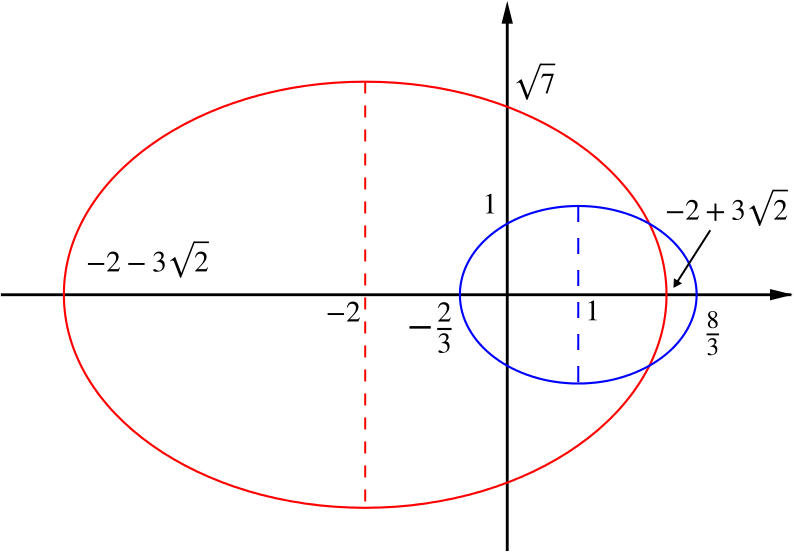
The two ellipses appear here in red. A possible circle through their intersections is in blue.
Solution
To get some sense of what is going on in this question, it is helpful to sketch a graph.
Both ellipses are symmetrical in the -axis, since replacing with makes no difference to the equations.
The second ellipse is symmetrical in the line , since if we substitute in and into the equation, we obtain the same values for . Likewise, the first ellipse is symmetrical in . (For more on this idea, have a look at Quadratic symmetry.)
If we put , and then into each equation, we can find the intercepts with the axes.
Alternatively, we could observe that the centre of the first ellipse lies at and its semi-axes have length in the -direction and in the -direction. Likewise, the second ellipse has centre and semi-axes and .
Either of these approaches gives us enough information to sketch the ellipses.
(Though it is not obvious without a calculator whether or not, the question does tell us that the ellipses intersect. Our calculation of their point of intersection will then prove that they do, indeed, intersect, and it will follow that .)
We can now tackle the question asked.
We find the points of intersection of the two ellipses by solving the simultaneous equations and
We can eliminate
by multiplying the first equation by
and subtracting the second equation, giving
This gives the -value of the points of intersection as either or .
It is clear from our sketch that does not correspond to real points of intersection. (There are, though, complex points of intersection.) So we must have . (We could also find this by substituting into the equation of the ellipse and discovering that there are no real values of corresponding to it.)
Taking
and substituting into the first simultaneous equation, we have
Hence there are two (real) points of intersection, at and . (It’s easy to check that these points really do lie on both ellipses).
A circle through both these points has centre on the -axis, by symmetry.
Then the equation of the circle is The right-hand side here is the distance of the centre from , or from , squared.
Expanding gives
as required.
These circles form a system of coaxal circles; you might like to explore this concept further.