Can we show L<∫1rx1dx<R?
Question
Show, graphically or otherwise, that if
r
is an integer greater than
1
, then
L=21+31+41+…b+r1<∫1rx1dx<1+21+31+…b+r−11=R.
Determine whether 21(L+R) underestimates or overestimates the value of the integral.
Solution
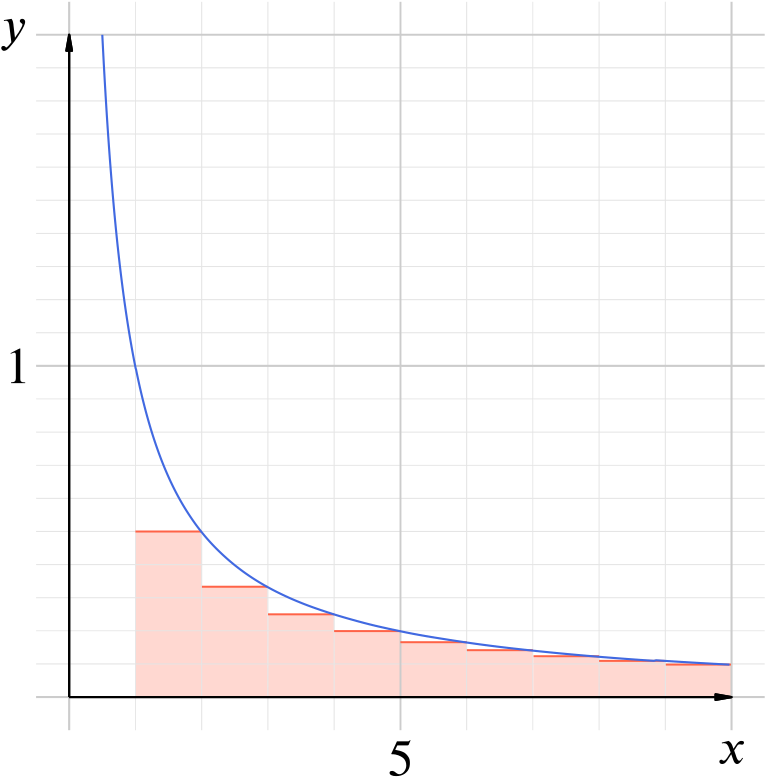
Consider the following graph.
The first red column in this image has area
21
, the second
31
, etc., and every such column lies under the curve
y=x1
; thus, for every
r
,
L=21+31+41+…b+r1<∫1rx1dx
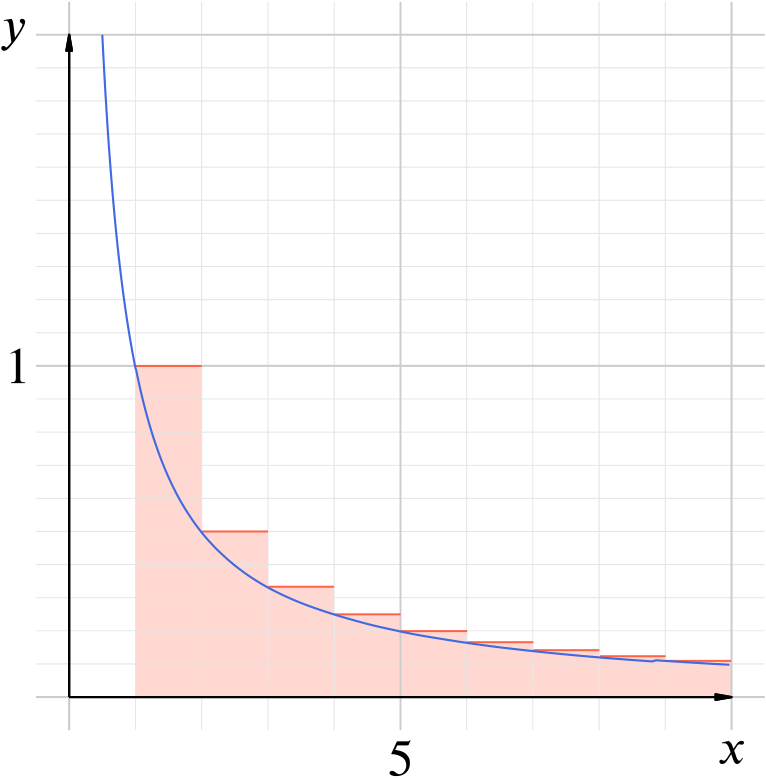
Similarly, we can consider another graph.
The first red column in this image has area
1
, the second
21
, etc., and the curve falls under the red horizontal line segments; thus, for every
r
,
∫1rx1dx<1+21+31+…b+r−11=R.
The series 1+21+31+…b is called the harmonic series. Can you use the inequality above to decide whether this series converges or diverges? You may wish to look at Harmonious proofs to explore this idea further.
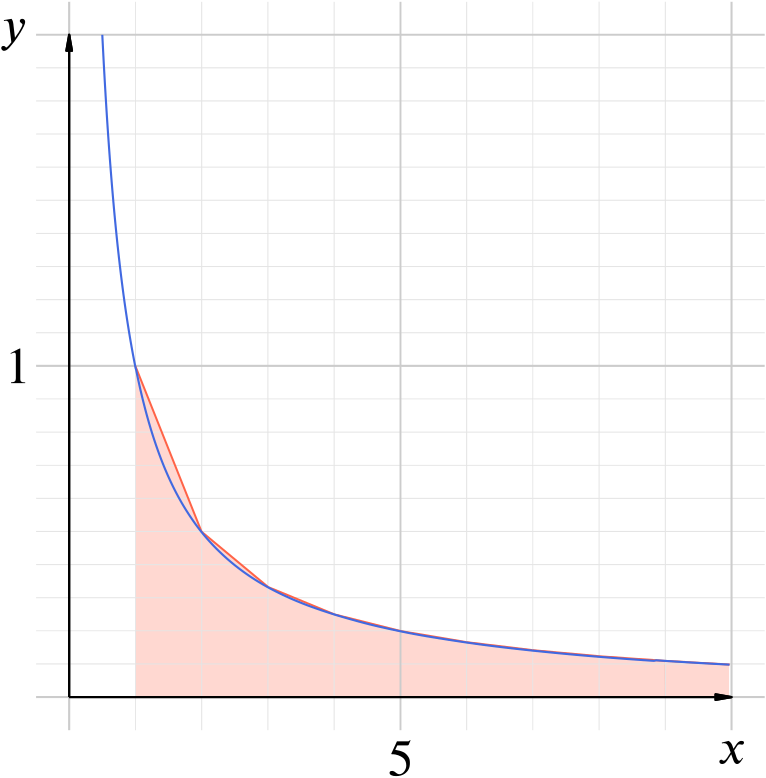
Consider the red shaded area in the following graph.
This area is, in fact,
2L+R
. Since the red broken line always lies above the blue line, the shaded area will always be greater than the integral, and so
2L+R>∫1rx1dx
for every r; that is, it’s an overestimate.
It turns out that the error
n=1∑r−1n1−∫1rx1dx=n=1∑r−1n1−logr
converges as r→∞ to a positive constant, γ, called the Euler–Mascheroni constant. This appears in a number of surprising places in mathematics, but it remains mysterious; for example, it’s unknown whether it’s irrational or not (although it almost certainly is).