Producing a rule
Excerpt: Students are invited to find a short-cut to differentiating quadratics written in factorised form. The rule may need to be adapted as more complicated examples are encountered.
Warm-up
Differentiate these functions and compare the results with the original functions.
- What do you notice?
If you don’t notice anything, or you want to check out whether there is a pattern emerging you could try a few more examples of your own.
- Can you create a rule to find the derivative of a function like this without expanding the brackets?
Solution
Since could be written then
and since could be written then .
If we compare these with the original functions we can see that each derivative is the sum of the two brackets that were multiplied in the original function.
-
Can you understand why this happens?
-
Will this always be the case?
Problem
Try applying the rule you came up with in the Warm-up to these functions.
-
Does your original rule give you the correct derivative for these functions?
-
If your original rule works for these functions, can you justify why? If not, then can you adapt your rule to make it work for all of the examples so far?
Now try these
Does your (new) rule work for ?
If not, try to adapt it.
Now try it on .
What have you noticed?
Things you may have noticed
Try applying the rule you came up with in the Warm-up to these functions.
-
Does your original rule give you the correct derivative for these functions?
-
If your original rule works for these functions, can you justify why? If not, then can you adapt your rule to make it work for all of the examples so far?
From the Warm-up, we had a rule that said, add together the brackets to find the derivative.
If we start to look at these, we don’t seem to be able to use this rule. In , we see that the expansion will give us so our derivative needs to include , but following the rule of adding the brackets would give us .
We could check it out thoroughly by expanding and differentiating:
But , which is not equal to the derivative. We notice that we’re out by , which means that the derivative is actually .
-
How could we adapt our rule to work for these examples?
-
Can we find a similar way of creating the derivatives of all these functions?
-
Could we adapt our rule for any pair of linear brackets, or something more general (think about what that might be)?
Alternatively we could rewrite the original function to have brackets starting with only a single , so for we have .
- Now what would the adaptation to the rule be? How are these two versions linked?
Now try these
Does your rule work for ?
If not try to adapt it.
For this function, adding constant multiples of the brackets will not work. We can see that expanding it would give us a quartic expression, so the derivative will be cubic.
What would we need to multiply the brackets by before adding, to get the right answer this time?
We might think of applying the chain rule by rewriting this as where . Our original rule would then give .
Now applying the chain rule gives .
Can we find a way to adapt our earlier rule to account for this?
Looking at might give us a hint about how to adapt the rule so that it works for all cases. We can’t use the chain rule here because one bracket is linear, but the application of chain rule above might give us a hint for a general adaptation.
Again we can see that expanding would give us a term which would differentiate to . As only one bracket contains we would have to multiply that bracket by before adding, but there doesn’t seem a good reason for using . Thinking still about multiplying and adding, we could instead multiply the second bracket by to give us the total of when added to the quadratic bracket. We might derive from the first bracket by differentiating, this is similar to using the coefficient from a linear bracket so there seems like a good reason for doing it.
General rule
We have gradually worked up in complexity to see that rather than expanding brackets to create a single polynomial to differentiate, we can instead multiply each bracket by the differential of the other and add them. So for polynomials and if then .
This is called the Product Rule and can be shown to be true for any functions, not just polynomials. You might like to read this explanation.
A certain perspective
In the Problem section, we found out that the derivative of is . It turns out that we can use this result to differentiate the product of any two functions, and in this section, we explore how to do so.
Our key question is:
What is the derivative of the product for any functions and ?
We will find the derivative of at the point .
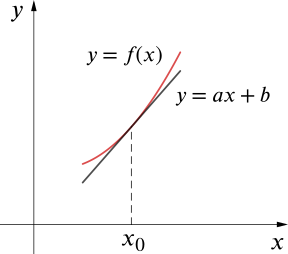
In A tangent is…, we saw that we can locally approximate any function by a straight line (so long as we avoid any points where the gradient is not well defined). So near , for some and .
We can find and by matching the gradients and -values: Likewise, near , where and are such that and .
So near , we have , so using the rule we found out, we see that the derivative of at is . Substituting in our values for , , and , we find So in general,
An alternative notation which is commonly used is to write and . Then we have