Inequalities for some occasions
Excerpt: Students are given three conditions and asked to fill a Venn diagram with quadratic inequalities that satisfy some, none, or all of the conditions.
Problem
Can we find a quadratic inequality for each region of the Venn diagram?
The regions are defined as follows.
A: The solution set is a subset of .
B: The solutions are given by where and are real numbers.
C: The inequality is satisfied by , e.g. satisfies the inequality .
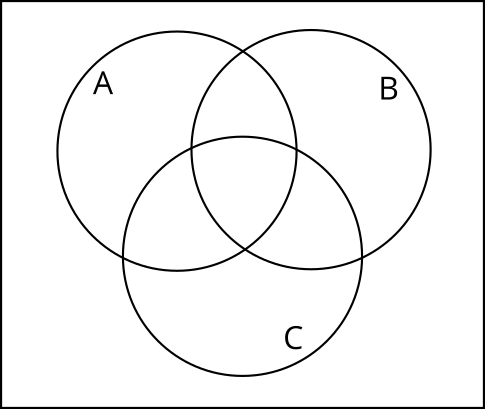
Here are some possible inequalities. Start by placing these into the correct region of the Venn diagram.
Suggestion
If our inequality needs to be satisfied by and , what values for and could we choose?
If satisfies the inequality, but the inequality cannot be written in the form , what form will it take?
Some of the regions of the Venn diagram might be empty. Can you find a quadratic inequality to fit this region? If not, can you explain why it is impossible to fill this region. It may be useful to try and sketch a graph of the situation.
Solution
We will solve the given quadratic inequalities so they can be placed in the Venn diagram. We will start with the more straightforward ones.
| From the graph we can see are the only real values of that satisfy the inequality. Therefore, this inequality satisfies condition B only. |  |
|---|
| This inequality satisfies conditions B and C. |  |
Does it matter whether we move the terms to the left or the right hand side of the inequality? What would change if we solved instead?
| , This inequality satisfies condition C. |  |
| Divide both sides of the inequality by , This inequality does not satisfy any of the conditions. |  |
Why can we divide both sides by ? How does the graph of compare to the graph of ?
| This inequality satisfies conditions A and B. |  |
| , This inequality satisfies C only. |  |
| From the graph we can see that this inequality is true for all real values of . Therefore, this inequality satisfies C only. |  |
|---|
We didn’t try to solve this algebraically because of what we know about . What would happen if we did try to solve it algebraically?
| The discriminant of the quadratic is . This means there are no real solutions to the quadratic equation and therefore no real solutions to the quadratic inequality. This can be seen from the graph. For all real values of , it is impossible for the graph to be greater than the graph . Therefore, this inequality does not satisfy any of the conditions. |  |
|---|
What other graph might we have sketched to see there are no solutions?
Here are the given inequalities presented in the Venn Diagram.

It is impossible for a number to be less than 1 and equal to 4 simultaneously. Therefore it is impossible to fill these regions.
Are there any inequalities which satisfy conditions A and C or conditions A, B and C?
One of the ways for the solution set to be a subset of is if it is bounded by two values, e.g. , but this would mean the solution set also satisfies condition B.
Another would be if the solution set only has one bound, e.g. , but this is impossible for a quadratic inequality.
However, we could consider a case whose solution set is a point, e.g. has the solution set which satisfies condition A only.
There is some discussion about this solution, as this can also be written as which then means it also satisfies condition B.
You might have suggested a quadratic inequality with a solution set such as (using different inequality signs) and this would indeed satisfy only condition A. However we chose to only use the signs and .
Are there any inequalities which satisfy only condition A?