Compose!
Excerpt: Students are given four functions and asked to compose them to create the given set of six new functions.
Problem
Part of the definition of a function is the specification of its domain. The choice of domain may affect the range of the function.
What is the largest possible domain for each of the functions
to
and what is the corresponding range?
The functions above have been composed in some way to make the following new functions:
Can you work out which functions have been composed and in what order to make the new functions?
What are the domain and range for each composition of functions above?
Note that the composition might only be defined on a smaller domain than is possible for the function .
Looking at each composition in turn,
- Can you match it with original functions that have similar features?
- Can you eliminate any of the original functions that cannot possibly be involved in creating it?
Prompting questions
Solution
To find the domain and range for a function, it sometimes helps to sketch its graph.
We can sketch the graph of , and is a translation of it—in which direction?
can be evaluated for any input so the domain of is all real numbers, which can be written as . The range is .
Function
The domain and range are both the full set of real numbers, .
Function
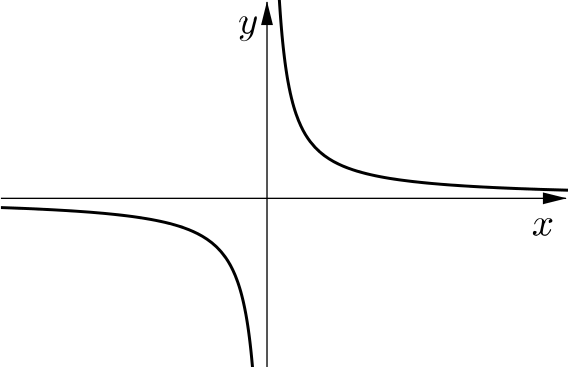
Allowing would produce an undefined result so we need to restrict the domain to . No input value can achieve so the range is also restricted to the real numbers excluding . but it's now fixed.
This version used to make the image crash into the bottom of the box in PDF
This version works in both outputs but wastes some space in HTML Allowing would produce an undefined result so we need to restrict the domain to . No input value can achieve so the range is also restricted to the real numbers excluding .
Function
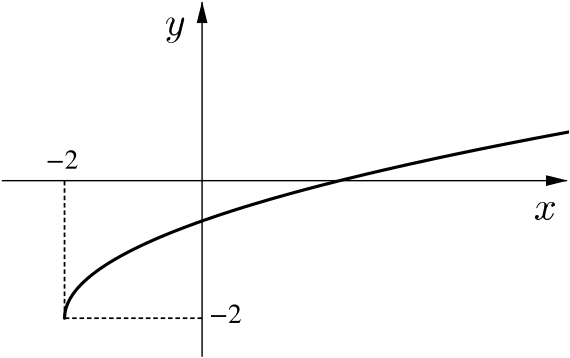 The graph of this function is a translation of .
The square root is undefined when so the domain of this function is .
We can evaluate and the square root function always increases as increases, so the range is .
This version used to crash the box in PDF. It wastes less space in HTML but chalk doesn't clear the float so I've had to de-chalk it
This version works in both outputs but wastes some space in HTML The graph of this function is a translation of . The square root is undefined when so the domain of this function is . We can evaluate and the square root function always increases as increases, so the range is .
Function
Note that the composition might only be defined on a smaller domain than is possible for the function .
We can see that this contains , suggesting function , and the form “” hints at being involved. , giving us
The notation is used to mean .
Using means the domain is and since we cannot achieve 4 from . Hence the range is . Can you illustrate this with a sketch of ?
1.
We require a quadratic which leads us straight to . We don’t want any fractions, so we’re probably going to compose it with the linear function . Notice that we want the coefficient of to be which we could achieve by squaring .
We try and see that
We can allow any input value, hence the domain is . As , it follows that has the same range as , so .
2.
The fraction means we probably need to use , and the indicates , but . We need the coefficient of in the denominator to be , so first applying before will do this and helpfully it will also remove the unwanted .
Since we have
To determine the domain and range we note that for (which is applied first) the domain is the real numbers and the range is . This becomes the input of so . The domain of excludes so we must exclude that output from . We do this by excluding the input of . This means that the domain of is and it has range .
3.
Notice that the function gives the positive square root, so in order for to equal as required, must be non-negative.
This gives the restricted domain of . We need to check whether the domain is further restricted by the functions and . The domain of is which includes all of . Even with the restricted domain, the range is . This becomes the input of and matches its domain, so has the same range as .
The composed function therefore has domain and range .
We notice the similarity to the function
, but
has a quadratic term—how could we cancel that out?
contains the square root of
, so if we apply
to the output of
we get
4.
We might look at this and think about function , but we need the input to this to be which doesn’t immediately look like any of the other functions.
It might be a good idea to change tack and think what we can generate by composing some of the functions with themselves.
- Since is quadratic will be quartic. So this is not going to help! The notation is used to mean .
- That is what we need as input for so
The domain and range of are the real numbers, , but the domain of excludes zero so we must exclude from the input of the composition. Hence its domain is and its range is .
5.
This is another case of a function composed with itself.
We might suppose that the domain and range of would be the real numbers, but because it was created by composing we have to exclude from both.
Does this in fact mean that is not the same as the function ?
6.