Between the lines
Excerpt: Find the area of a region between two straight lines given minimal information. This task involves the geometry and equations of straight lines.
Warm-up
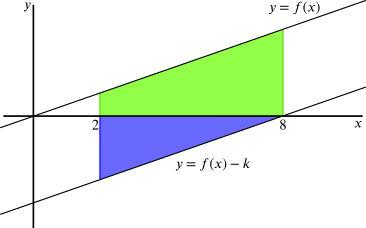
What can you say about this diagram?
Are there any questions that you would ask about the diagram?
Problem
In the diagram below is a linear function.
The area of the green shaded region (above the -axis) is square units.
What is the area of the blue shaded region (below the -axis)?
Suggestion
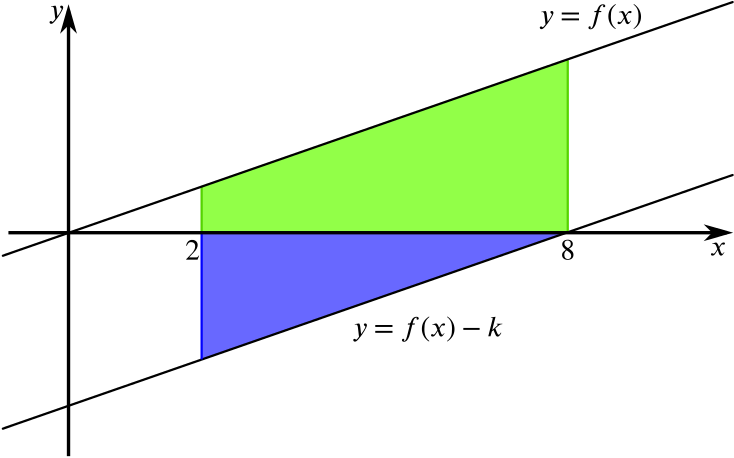
Take a step back, look at the image and write down anything that you know about it (without doing any calculations).
Some things you might have written
-
passes through the origin.
-
is a straight line.
-
could be written in the form (where in this case).
-
is parallel to (it is a vertical translation by units downwards).
-
The green region is a trapezium of ‘height’ units.
-
The blue region is a triangle of ‘base’ or ‘height’ units.
-
The combination of the green and blue shaded regions produces a parallelogram.
-
The blue triangle could sit ‘on top of’ the green trapezium to create a rectangle.
-
The area of the blue triangle must be less than square units.
Solution
There’s more than one way in which we could calculate the area of the blue triangle. For most methods that we might consider we will need to identify the value of when (let’s call this ) and when (let’s call this ).
How do we know that identifying these two values, and , is a good strategy and will provide enough information to solve the problem?
In order to identify these two values we might begin by writing down an equation involving them. This could be the area of the green trapezium which can be written as
Rearranging this we find that
In order to identify the unique values of and we now need a second equation containing these two unknowns.
We know that
where
is the gradient of the line. Because this is a straight line, the gradient,
, will be the same when
and when
and therefore we can write
which can be rearranged to give
Notice that we could have obtained this second equation by considering similar triangles instead.
The purple and yellow triangles are similar and related by a linear scale factor of . Therefore .
Solving equations and simultaneously we find that and .
Now, the area of the blue triangle can be calculated directly if we first calculate the perpendicular height of the blue triangle as . Then we can calculate the area of the blue triangle as
Notice that the area of the blue triangle is less than square units. Is this what you expected?
It is also worth noting that, whilst we didn’t need it in order to solve the problem, we now know that and that the translated line has equation which can also be written as
An alternative approach
We can also solve the problem without working out the values of and explicitly.
Since the lines are a distance of apart, we have . By similar triangles, as above, .
Therefore the green trapezium, which has ‘height’ and parallel sides of and , has area
The blue triangle also has ‘height’ but its base is . Therefore its area is
Therefore the ratio of the green area to the blue area is to , and so the blue area is
Reflection
-
At first sight, it may not have looked as though there was enough information to solve the problem. Why was it possible?
-
How can you generalise the problem?
