Average speed
Excerpt: This resource has two interesting situations that require students to think carefully about how average speed is calculated, and in turn, think about different types of averages.
Situation 1
| - miles | - miles | |
|---|---|---|
| Driver | ||
| Driver | ? |
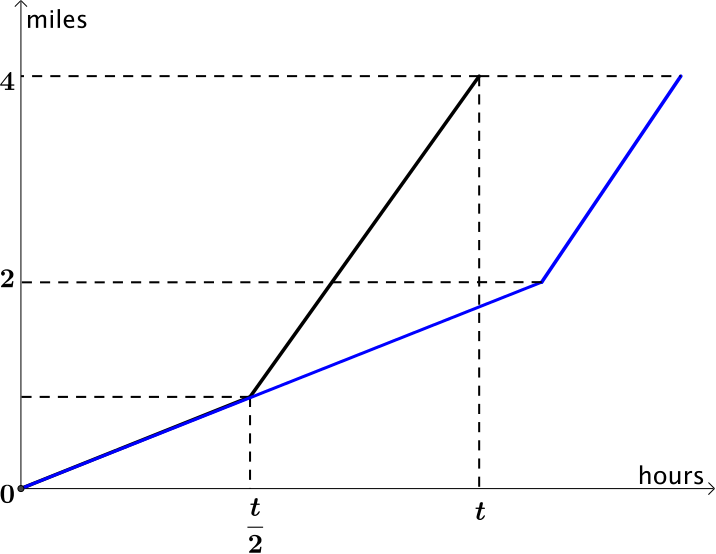
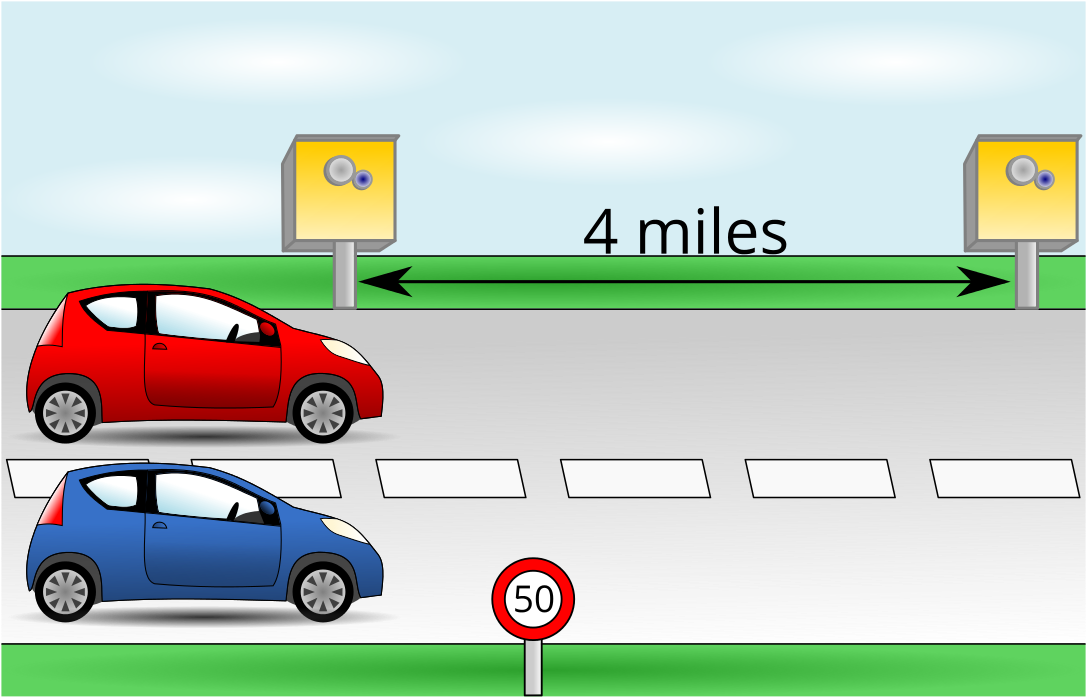
- The two drivers travel along the road shown in the diagram above. They pass the two average speed cameras at the same time as each other. How far apart will the cars be after the first driver has gone mile? What will be the greatest distance between the two drivers and when will it occur? What is the average speed of the second driver? What was the second driver’s speed for the last mile?
Suggestion
Sketching a distance-time graph from the information in the table might be a useful starting point.
Solution 1
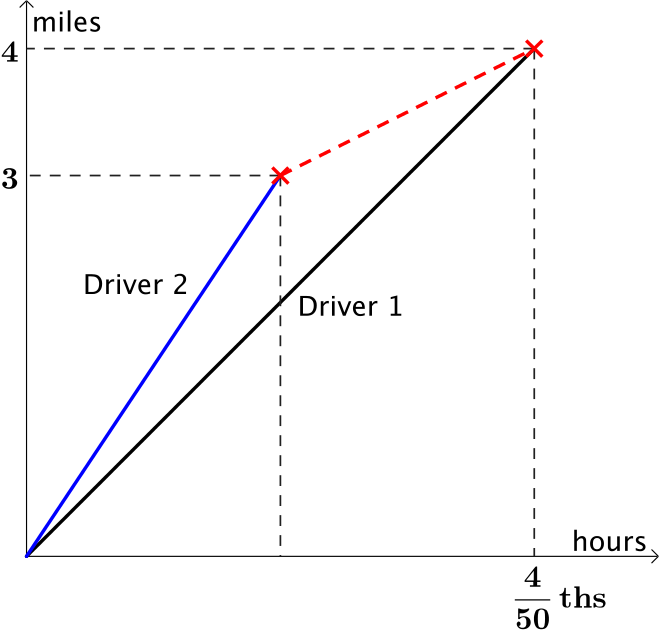
The graph above shows the information we were given in the table, with the speeds of the drivers represented by the gradients of the lines. How can we use it to help us solve the problem?
It is always a good idea to sketch a graph of a situation. It can help you visualise situations, highlight differences and similarities, and offer you a geometric way to solve a problem.
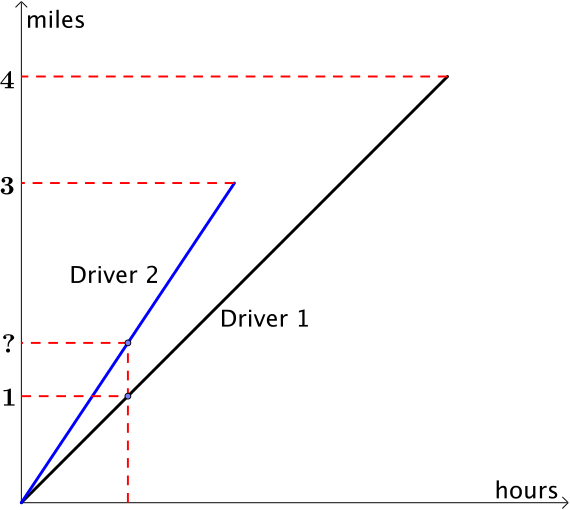
- How far apart will the cars be after the first driver has gone ?
After driving at the first driver has been travelling for th of an hour or minutes. Therefore the second driver has travelled a distance of so the cars are apart.
We could also have thought about the ratio of the speeds. The second driver is going times as fast as the first driver, so he will travel times as far in the same time.
- What will be the greatest distance between the two drivers and when will it occur?
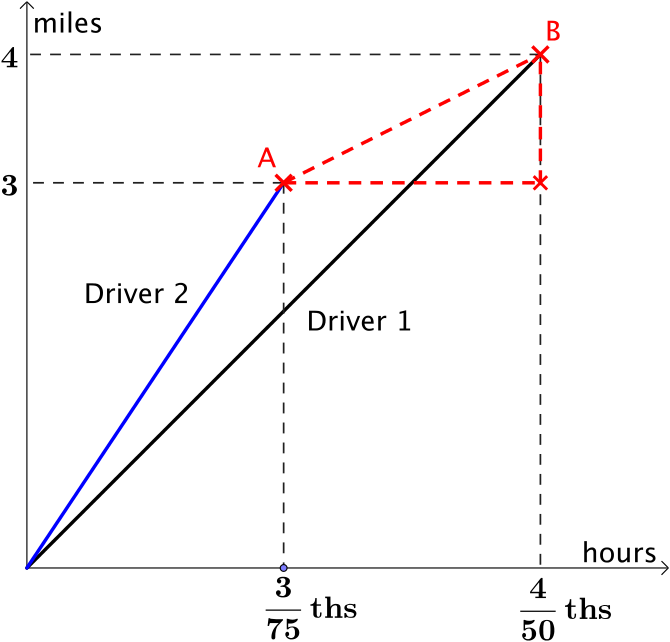
Both drivers arrive at the second speed camera together so we could add in the second driver’s journey to the graph.
The cars will be the greatest distance away from each other when the second driver has travelled . This occurs at ths of an hour or minutes. In this time, the first driver will have travelled . The gap between them will be .
- What is the average speed of the second driver?
Both cars travel the same distance in the same amount of time, so the second driver must also be averaging mph in the situation above.
- What was the second driver’s speed for the last mile?
The line we have drawn in represents the second part of their journey. The speed of the car is equal to the distance divided by the time taken.
We know the coordinates of A and B so we can calculate the speed as,
An algebraic approach
If we hadn’t drawn the graph we could have taken an algebraic approach to finding the solution. To work out the speed of the second driver once he has slowed down we need to consider his overall journey in two sections.
In the first section we know the speed and the distance so we have
In the second section we only know the distance so we can write where is the speed.
Subscripts can be very useful in questions like this, so as not to get confused. The times for each section will be different, which could be easily forgotten if we just used for both equations.
As , for the overall journey, with an average speed of mph and a distance of , we have
Rearranging this equation gives us the total time,
You might have also found the total time by working out the time that the first driver took.
Substituting in the equations for and from above we get
Solving for gives us a speed of . So our driver must travel at to make their average speed over the .
Situation 2
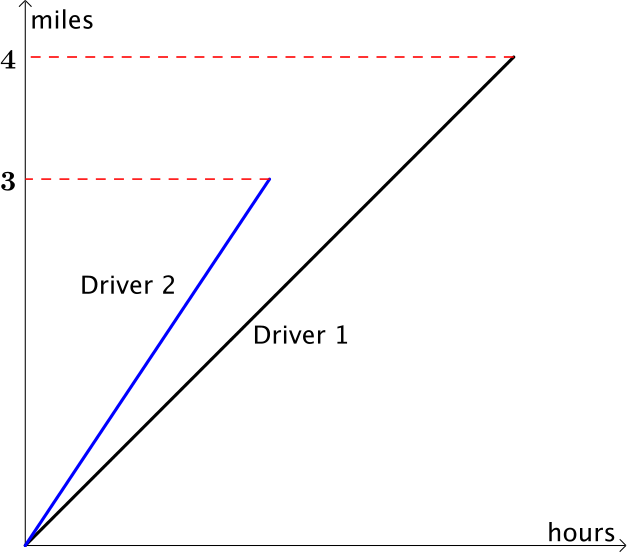
We are still along the same stretch of road, with a speed limit of , and the average speed cameras set at apart. In this instance our first driver spends the same amount of time driving at as he does at . Our second driver drives the first half of the distance at and the second half at .
-
What are the average speeds of each driver? Will either of them be caught speeding?
-
What happens if the speed cameras are apart instead? What changes?
Suggestion
It’s often a good idea to sketch a graph, even if you don’t need it to solve the problem. If you sketch the distance-time graphs here, it can help you visualise the two situations and highlight the differences between them. Look back at the solution for the first situation to see how the graphs were used.
Solution 2
What are the average speeds of each driver? Will either of them be caught speeding?
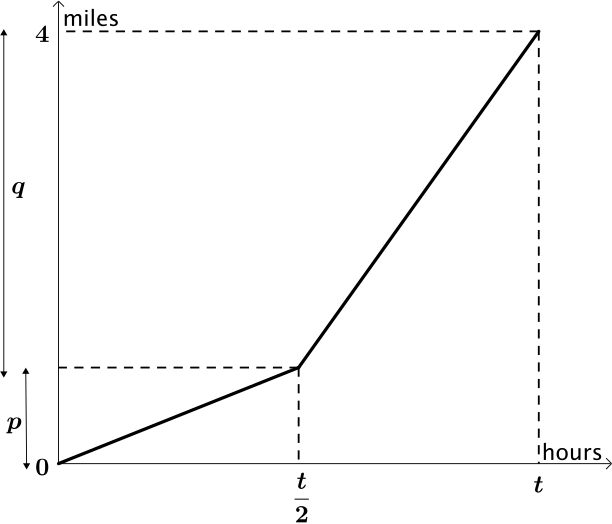
Let’s start with the first driver, who travels half the time at and half the time at . This is represented by the graph above.
We have two different ways to think about the journey; as a whole, and split into its two pieces.
We can write the speeds of the two pieces as where and are the distances travelled.
The journey as a whole can be written as
We know that but it turns out that substituting this into the equation is not helpful.
Therefore we can substitute in values for and in terms of , which leaves us with an average speed of .
What do you notice about the average speed? Could you have reasoned through this answer more easily, without doing the calculations?
Now we come to the driver who travels half the distance at each speed. Again we can think about the parts of the journey and the journey as a whole.
The separate parts can be written
Will they spend a longer time travelling at or at ?
The whole journey gives us
Rearranging the above equations to find and and then substituting these in gives
Do you think that either driver will be given a speeding ticket?
What happens if the speed cameras are apart instead? What changes?
Did you find that anything changed as the distance increased? Does this surprise you? Can you prove your findings for any distance?
Check your solution
If we look back at the equations we solved for the first driver, when the times were equal, we had as the distance, which we knew equalled , but we did not need to use this fact.
Whatever the distance, we would have the same first set of equations and the same second equation where total distance travelled.
We could rearrange these to write so the distance does not affect the average speed.
It is the same in the second case, although perhaps less obvious. If instead of miles we have miles, then we get the equations and
Rearranging the first two equations in terms of and means we we can write this as and simplify it to
Therefore this average also does not depend on the distance travelled.
Can you also explain graphically why the average speed for each situation does not depend on the total distance?
We have calculated two different average speeds. Often when people say ‘average’ they mean one particular type. Think about other averages you have met - do either of these two calculations remind you of averages you already know?
For equal distance spent at each speed
and for equal time spent at each speed
To think more about this go to the Averages section.

Averages
We have calculated two different average speeds. Often when people say ‘average’ they mean one particular type. Think about other averages you have met - do either of these two calculations remind you of averages you already know?
For equal distance spent at each speed
and for equal time spent at each speed
When people say ‘the average’ they are usually saying ‘the mean’. You know there is more than one type of average, but informally using ‘the average’ is often acceptable.
However it might surprise you that even saying ‘the mean’ is not enough, as there is also more than one type of mean. The mean you are most familiar with is actually called the ‘arithmetic mean’.
You may have spotted that when finding the average for equal times, we arrived at which is the arithmetic mean of and .
What is probably less familiar is the scenario of equal distance which led to which is the harmonic mean of and .
There are three means known as Pythagorean means, which are the arithmetic mean, the harmonic mean and the geometric mean. For positive numbers
, …,
, these are given by
Let us make our driving examples more general. We already know that the distance does not affect the means when we are driving for an equal time or an equal distance.
If we make the speeds and , what is the average speed when driving an equal time at each speed?
Solution
so the average speed would be
which is our arithmetic mean of and .
If our speeds remain and , what is the average speed when each is driven for an equal distance?
Solution
This time
so the average speed would be
which is the harmonic mean of and , and can also be written in the form
Will one of the averages always be bigger than the other?
Suggestion
In which of the situations do you spend the longest time at the faster speed?
Solution
We can see from the graph that travelling for an equal length of time at both speeds means that you spend longer travelling at the higher speed than when you travel an equal distance at both speeds. Therefore you will cover the distance in a quicker time and have a greater average speed.
We can also prove this algebraically. If we subtract the harmonic mean (equal distance), away from the arithmetic mean (equal time), we get
If we then simplify the numerator we have
which can be factorised to
The numerator will never be negative as it is squared, and the denominator will always be positive as and are always positive. Therefore
So the average speed when driving for equal time will always be greater than or equal to the average speed when driving for equal distances.
The result in the question above generalises to more than two speeds. In fact the harmonic mean is always less than or equal to the geometric mean, which is always less than or equal to the arithmetic mean for the same set of positive numbers.
The part of this result that is used the most often only involves the arithmetic and geometric means.
This is more commonly known as the AM-GM inequality, and appears more regularly than you might think. You might like to try this review question or this one that it appears in.
Let us now think about a type of question you may well have seen before.
If the (arithmetic) mean height of a class of 30 pupils is m, and the mean height of a class of pupils is m, what is the mean height of all the pupils?
Suggestion
What is the total height of all pupils?
Solution
We cannot just take the mean of and as they are unequally weighted.
One way is to work out the total height of each class.
The class with pupils has a total height of m.
The class with pupils has a total height of m.
So the average height of all pupils is
A different way of thinking about it is the proportion each class contributes to the average. The class with pupils accounts for of the total and so we could write the calculation
This is what we call a weighted arithmetic mean, as the two different heights are contributing unequal amounts to the mean.
Now let us consider a car travelling at a speed for a time and then travelling at speed for time . What is its average speed?
We have
so the average speed is given by
If we rearrange the formulae for and to get them in terms of and then we can substitute these into the formala for average speed to get
which can be written as
which is a weighted arithmetic mean, where we are taking the proportion of time that has been travelled at each speed into account.
From this general case we can return to our special case of equal times.
If you make , can you show the formula simplifies to the arithmetic mean?
If you start again, you can rearrange the formulae for and to get them in terms of and , and so get a formula for average speed in terms of , , and that is a weighted harmonic mean. Can you return to our special case of equal distances from your formula?