Binary Trees (Cambridge International A-Level Computer Science)
Exam board Cambridge International · A-LevelUpdated 2025-06-03
Binary trees
What is a binary tree?
-
A binary tree is a rooted tree where every node has a maximum of 2 nodes
-
A binary tree is essentially a graph and therefore can be implemented in the same way
-
You must understand:
- Tree traversal of a tree data structure
- Add new data to a tree
- Remove data from a tree
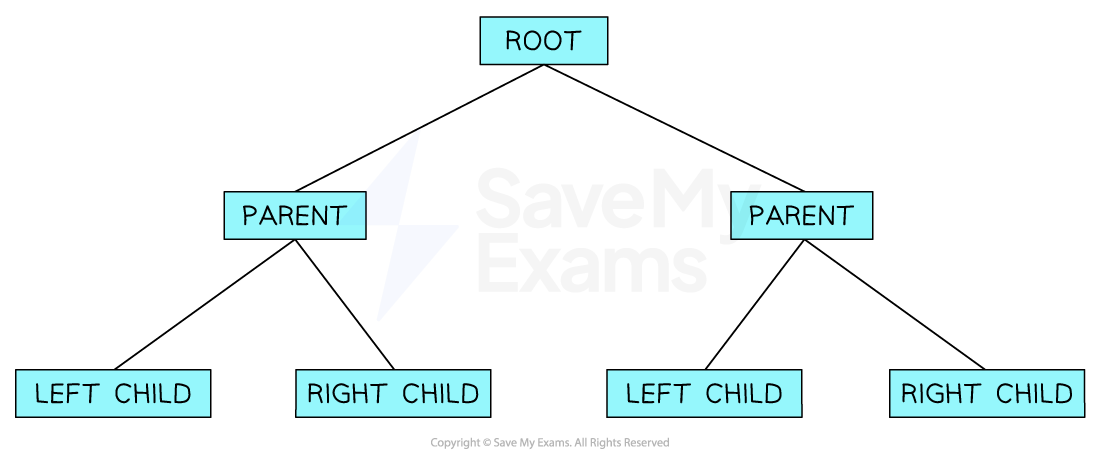
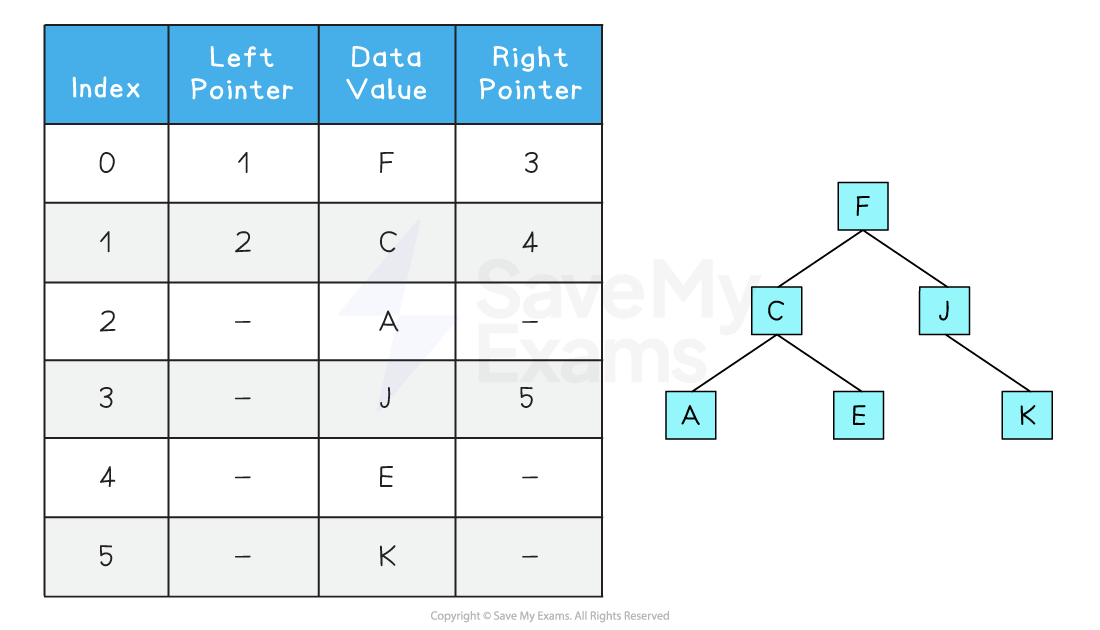
- The most common way to represent a binary tree is by storing each node with a left and right pointer
This information is usually implemented using 2D arrays
Tree terminology
| Keyword | Definition |
|---|---|
| Node | An item in a tree |
| Edge | Connects two nodes together and is also known as a branch or pointer |
| Root | A single node which does not have any incoming nodes |
| Child | A node with incoming edges |
| Parent | A node with outgoing edges |
| Subtree | A subsection of a tree consisting of a parent and all the children of a parent |
| Leaf | A node with no children |
| Traversing | The process of visiting each node in a tree data structure, exactly once |
How do you program a tree?
-
In the following example:
-
A tree is represented using a
TreeNodestructure, which includes:- A
valuefield to store the data held in the node - A
childrenfield to store a collection (e.g. list or array) of child nodes
- A
-
The
createTreeNodefunction is used to initialise a new tree node, setting its value and creating an empty collection for its children -
The
addChildfunction allows a new child node to be added to a parent node- It creates a new
TreeNodewith the given value and appends it to the parent'schildrencollection
- It creates a new
-
Finally, the
createTreeNodefunction is used to create the root node- Additional child nodes are added using the
addChildfunction, allowing a multi-level tree structure to be built with branches and sub-branches
- Additional child nodes are added using the
-
| Pseudocode |
|---|
| Python |
|---|
| Java |
|---|
Algorithm to traverse a tree structure
| Pseudocode - pre-order tree traversal |
|---|
| Python - pre-order tree traversal |
|---|
| Java - pre-order tree traversal |
|---|
- For a tree like:
Root├── Child 1│ └── Grandchild 1.1└── Child 2 - The output will be:
RootChild 1Grandchild 1.1Child 2
Algorithm to add data to a tree structure
| Pseudocode |
|---|
| Python |
|---|
| Java |
|---|
- These examples all create a new node with the provided value and attach it to the given parent node
- This approach allows dynamic construction of trees with multiple levels
Algorithm to remove data to a tree structure
| Pseudocode |
|---|
| Python |
|---|
| Java |
|---|
- This only removes the first matching child from the direct children of a node
- If you want to remove nodes anywhere in the tree, you’d need a recursive version
REMOVEanddeland.remove()work because thechildrencollection is a list/array
Was this revision note helpful?
Build on this topic