Virtual Machines (Cambridge International A-Level Computer Science)
Virtual machines
What are virtual machines?
- Virtual machines (VMs) are entire operating systems running inside another operating system
- A user running Windows 11 could run a virtual machine of MacOS
- This would allow them to navigate the GUI of MacOS and install software on it
- Running a virtual machine helps access software that is only designed to run on specific operating systems
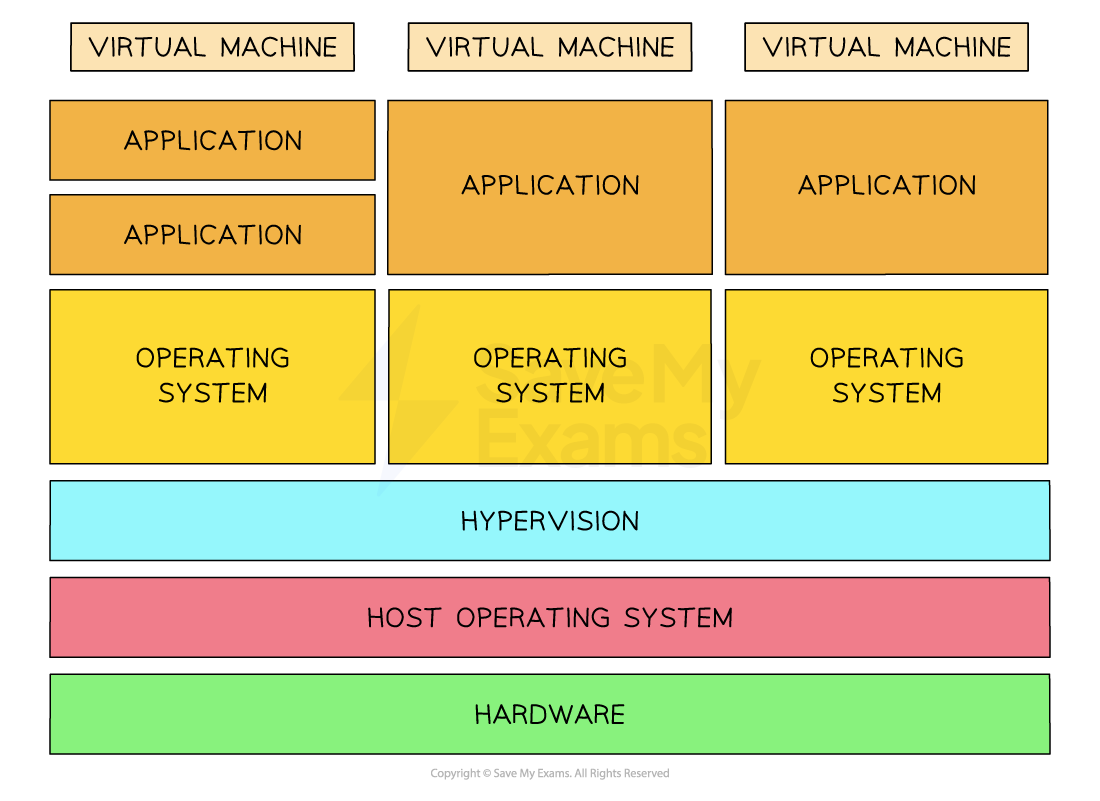
- VM management software includes a Hypervisor that monitors all activity happening inside the VM
Structure of several virtual machines running on a single piece of hardware
Cross-platform and forwards compatibility
- Not all software is designed to run on all operating systems
- Apple commonly makes software that only runs on MacOS for performance reasons
- A Windows user could run a virtual machine of MacOS and install the software they need
- Most software needs to be updated to work on the latest versions of operating systems
- A user running the latest release of Windows may need to run a virtual machine of a previous release of Windows to use an application that hasn't received a forwards-compatibility update
In software testing
-
VMs are a way to create isolated test environments, that leave the host operating system unaffected
-
Isolated environments allow a developer to:
- Monitor the way their software affects system performance
- Test on a clean-slate system, while no other applications are running
-
VM management software can create virtual machines that act like they have older hardware
-
This allows developers to build software that can be run on older hardware so that more users can use the software
-
A developer can test against various operating systems, such as MacOS, Linux and Windows, for greater compatibility
-
In A Level Computer Science, intermediate code is generated through compilation and allows programs to run across different operating systems
Consequences
-
VMs share the same system hardware as the host OS
-
Over-use of VMs can exhaust the host OS of the system of CPU, hard disk and memory
- VM software such as VirtualBox can set maximum limits on system resources
- A low-specification machine could be configured to allocate only 1GB of memory and 20% of CPU
- A high-specification machine could afford up to 8GB of memory and 50% of the CPU
-
Operating systems are commonly free to download, but require an activation payment to access all features
Was this revision note helpful?
Build on this topic