Encryption (Cambridge International A-Level Computer Science)
How encryption works
What is encryption?
- Encryption is a method of **scrambling data **before being transmitted across a network
- Encryption helps to protect the contents from unauthorised access by** making data meaningless**
- While encryption is important on both wired and wireless networks, it's even more critical on wireless networks due to the data being transmitted over radio waves, making it easy to intercept
How is wireless data encrypted?
- Wireless networks are identified by a 'Service Set Identifier' (SSID) which along with a password is used to create a 'master key'
- When devices connect to the same wireless network using the SSID and password they are given a copy of the master key
- The master key is used to encrypt data into 'cipher text', before being transmitted
- The receiver uses the same master key to decrypt the cipher text back to 'plain text'
- To guarantee the security of data, the master key is never transmitted. Without it, any intercepted data is rendered useless
- Wireless networks use dedicated protocols like WPA2 specifically designed for Wi-Fi security
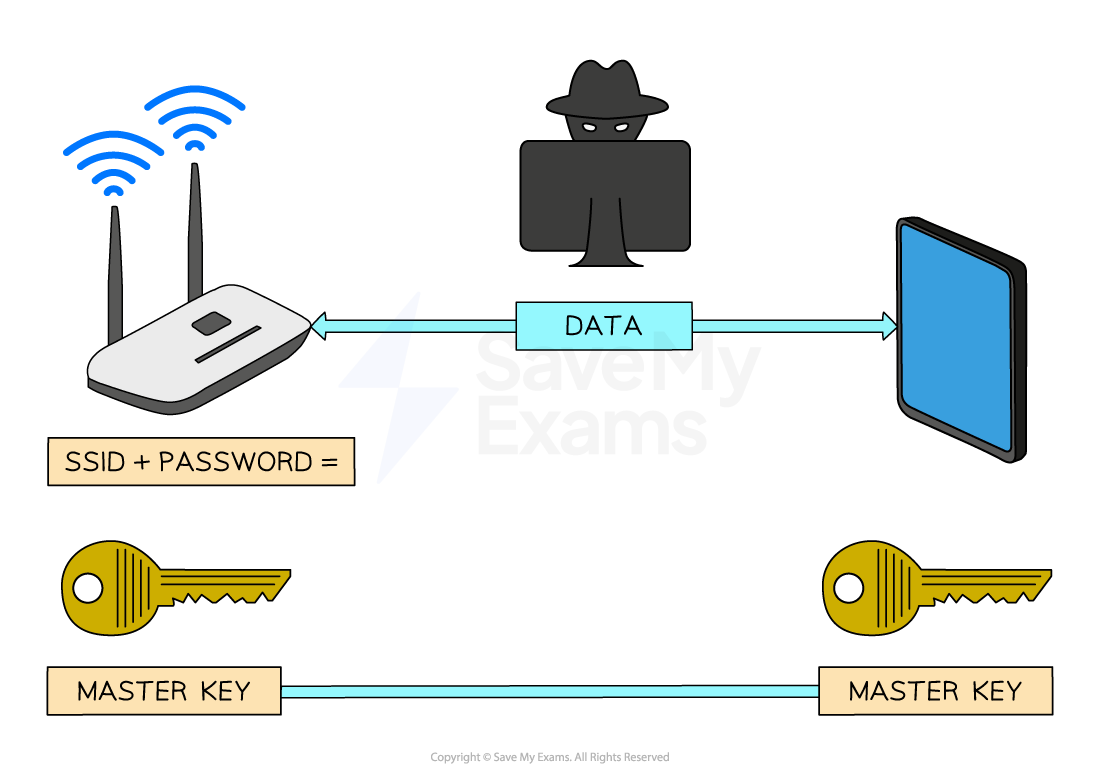
How is wired data encrypted?
- Wired networks are encrypted in a very similar way to a wireless network, using a master key to encrypt data and the same key to decrypt data
- Encryption on a wired network differs slightly as it is often left to individual applications to decide how encryption is used, for example HTTPS
Symmetric & asymmetric encryption
How does symmetric encryption work?
- The sender uses a key to encrypt the data before transmission
- The receiver uses the same key to decrypt the data
- It's usually faster, making it ideal for encrypting large amounts of data
- The significant downside is the challenge of securely sharing this key between the sender and receiver
- If a bad actor captures the key, they can decrypt all messages intercepted in transmission
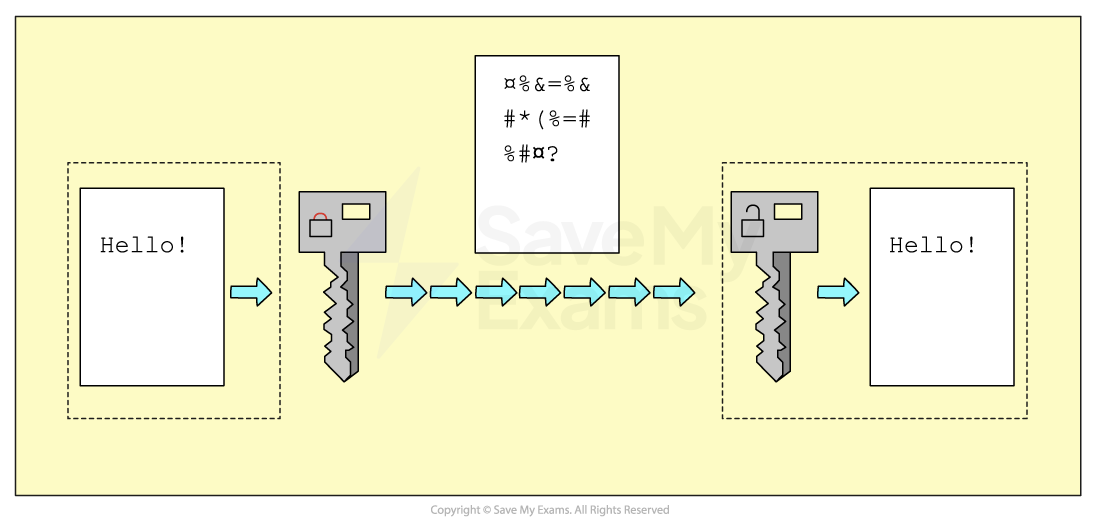
Structure of Symmetric Encryption
How does asymmetric encryption work?
-
Asymmetric encryption uses two keys:
- a public key for encryption
- and a private key for decryption
-
Receivers openly share their public key
-
Senders use this public key to encrypt the data
-
The receiver's private key is the only key that can decrypt the data and is kept locally on their side
-
The public and private keys are created at the same time and are designed to work together in this way
-
It is typically slower than symmetric encryption
-
It is generally used for more secure and smaller data transactions, e.g. passwords, bank details
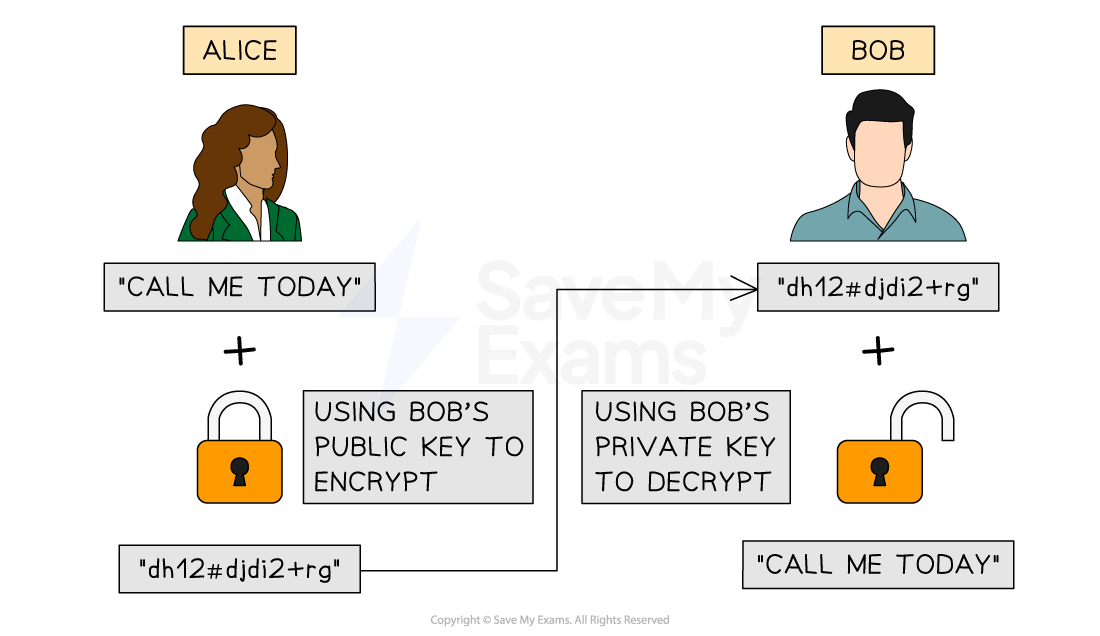
Structure of Asymmetric Encryption
Choosing an encryption type
- Symmetric encryption is fast but has key-sharing issues; asymmetric is slower but solves these issues.
- The choice should be made based on the situation's needs: whether speed or security is more critical.
| Encryption Type | Suitable For | Reasons to choose |
|---|---|---|
| Symmetric | Large files, databases | - Fast and efficient for bulk data. - The same person encrypts and decrypts, e.g. when backing up data. |
| Asymmetric | Confidential/secret communications | - Sharing highly secure data, e.g. passwords, government communications |
Quantum cryptography
What is quantum cryptograhy?
-
Quantum cryptography uses quantum mechanics to securely transmit encryption keys
-
Its main goal is to enable unbreakable communication by detecting any attempt to intercept or tamper with the key
-
The most well-known method is:
- Quantum Key Distribution (QKD) – uses quantum particles (like photons) to share a secret key between two parties securely
Benefits of quantum cryptography
| Benefit | Explanation |
|---|---|
| Unbreakable key transmission | Uses quantum physics – measuring a quantum state disturbs it, so eavesdropping is detectable |
| Eavesdropper detection | Any interception changes the quantum state of the key, alerting the users |
| Perfect forward secrecy | Keys are used once and then discarded, reducing the impact of future key leaks |
| Stronger than classical encryption | Not based on mathematical problems like factoring large primes, so it's not vulnerable to advances in computing (e.g. quantum computers) |
Drawbacks of quantum cryptography
| Drawback | Explanation |
|---|---|
| Expensive and complex | Requires advanced technology, including specialised hardware like photon detectors and fibre-optic channels |
| Short distance limits | Works best over short ranges (limited by current fibre-optic and signal loss issues) |
| Slow transmission speed | QKD is typically slower than traditional key exchange methods |
| Still evolving | Technology is new and not yet widely available or standardised |
| Only secures key exchange | Quantum cryptography secures the key, but not the actual data encryption itself – traditional algorithms still needed |
Exam Hint Quantum cryptography isn't about encrypting the message – it’s about securing the key used in encryption (e.g. with QKD). Always mention this to show clear understanding.
Worked Example Encryption is used to alter data into a form that makes it meaningless if intercepted.
Describe the purpose of asymmetric key cryptography.
Final answer: Answer
- To provide better security [1 mark]
- … by using two different keys / a public key and a private key [1 mark]
- One of the keys is used to encrypt the message [1 mark]
- … the matching key is used to decrypt the message [1 mark]
Was this revision note helpful?