Network Types (Cambridge International A-Level Computer Science)
Exam board Cambridge International · A-LevelUpdated 2025-04-01
Purpose & benefits of networking
What is a network?
-
A network is two or more interconnected devices (such as computers, printers, and servers) designed to:
- share resources
- exchange data
- communicate with each other
-
The purpose of a network is to enable data and resource sharing, communication, and collaboration
Advantages and disadvantages of networks
| Advantages | Disadvantages |
|---|---|
| Devices (e.g. printers) can be shared, reducing costs | Expensive setup – cabling and servers can cost a lot |
| Software licences for networks are cheaper than for individual computers | Difficult to manage – large networks need skilled administration |
| Users can share files and data easily | If the server fails, the whole network can be affected |
| Access to reliable, central data (e.g. from a file server) | Malware or hacking can affect the entire network |
| Files can be backed up centrally each day | Security risks increase if connected to a larger WAN |
| Users can communicate via email or messaging | |
| A network manager can control access rights and internet usage |
LANs & WANs
What is a local area network (LAN)?
- A local area network (LAN) is a network which has a small geographical area (under 1 mile)
- All of the hardware is owned by the company/organisation/household using it
- LANs will use unshielded twisted pair (UTP) cable, fibre optic cable or wireless connections (Wi-Fi)
Advantages and disadvantages of LANs
| Advantages | Disadvantages |
|---|---|
| Allows centralised management of updates, backups and software installations | If hardware fails, the network may not function properly or even at all |
| Can secure its devices with the use of firewalls, antivirus software and other security features to prevent unauthorised access | Networks are more prone to attacks than standalone computers |
| Allows users on the network to share resources such as printers and other peripherals | Access to data and peripherals can be slow depending on network traffic |
| Allows the users of the network to collaborate and share files and folders | Require maintenance to ensure that software is up to date, upgrades and backups which can be costly |
Wireless Local Area Network (WLAN)
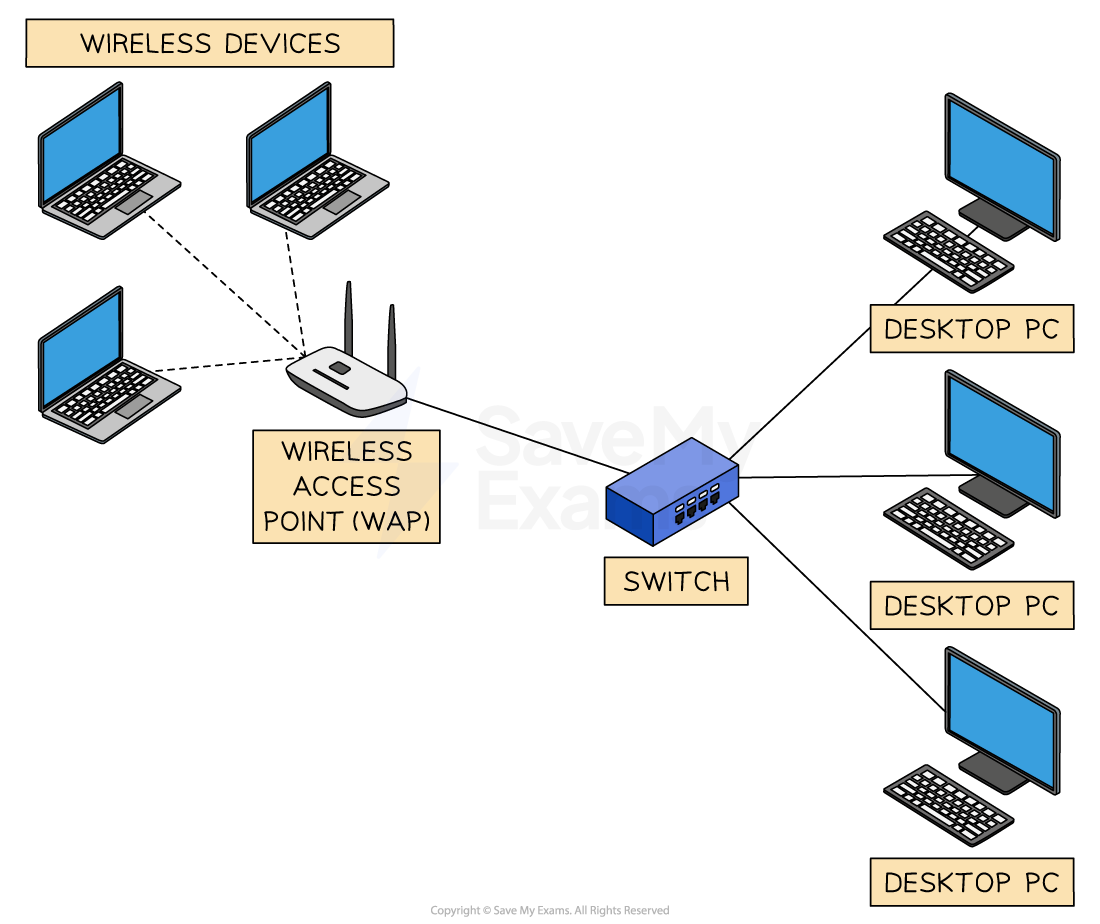
- A wireless local area network is a local area network where devices connect to the network **wirelessly **instead of using cables
- Extra hardware,** wireless access points** (WAPs) or hotspots are connected to the network so that users can connect using Wi-Fi
Advantages and disadvantages of WLANs
| Advantages | Disadvantages |
|---|---|
| Allows users to connect anywhere that is in the range of a Wireless Access Point (WAP) without the need for additional hardware or wiring. | **Limited **in their coverage and can be further affected by walls and other structures |
| Can be used in a** variety of environments** both indoors and out making them highly flexible | Bandwidth speeds can become an issue in high traffic areas |
| Additional wireless access points can be added relatively easily resulting in additional users being able to use the network or increased network coverage | Interference from other devices which can affect performance and connectivity |
| Access to peripherals such as printers | Vulnerable to security threats due to wireless signals being intercepted |
Wide Area Network (WAN)
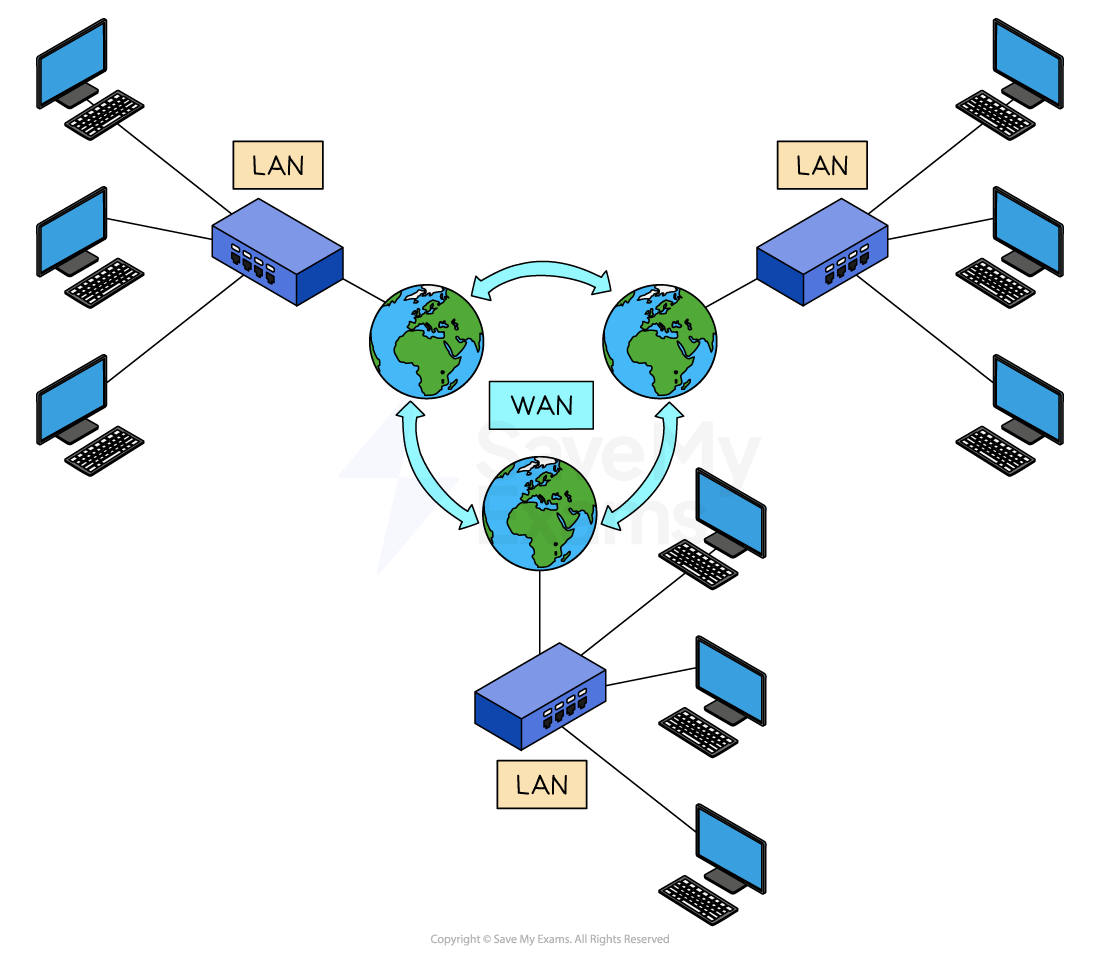
- A wide area network (WAN) is a network which has a large geographical area (over 1 mile)
- They are a collection of LANs joined together
- The computers on a WAN are connected via routers
- The hardware used to connect the networks together is not all owned by the company/organisation/household using it.
- For example, telephone lines owned by telecommunication companies
- WANs will use fibre optic cable,telephone lines and satellite to connect the LANs together
Was this revision note helpful?