Translation Skills (Cambridge International A-Level Computer Science)
Exam board Cambridge International · A-LevelUpdated 2025-04-18
Structured English/Flowchart to Pseudocode
Example - Structured English
A customer is buying an item. If the customer has a discount code, they receive 10% off the price. Otherwise, they pay the full amount. The program should ask for the item price and whether they have a discount code, then calculate and display the final price.
Step 1 - Structured English
- Ask the user to enter the price of the item
- Ask the user if they have a discount code
- If they do have a discount code → Calculate 10% off the price → Subtract the discount from the original price
- Otherwise → The price stays the same
- Output the final price
Step 2 – Identifier table
| Identifier | Description |
|---|---|
ItemPrice | Original price of the item |
HasDiscount | TRUE if user has a discount code |
DiscountAmount | Amount taken off the original price |
FinalPrice | Price after discount is applied |
Step 3 – Pseudocode
Structured English/Pseudocode to Flowchart
Example - Pseudocode
Step 1 – Identifier table
| Identifier | Description |
|---|---|
Number | The number entered by the user |
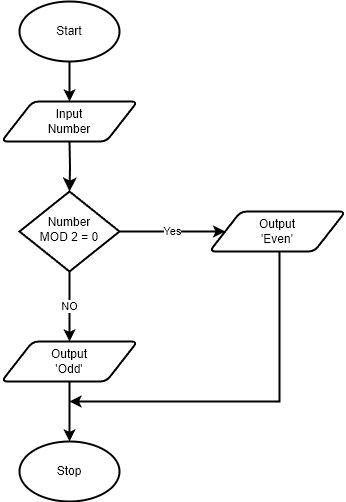
Step 2 – Flowchart structure
| Pseudocode statement | Flowchart symbol | Purpose |
|---|---|---|
INPUT Number | Parallelogram (Input/Output) | User enters a number |
IF Number MOD 2 = 0 | Diamond (Decision) | Checks if the number is divisible by 2 |
OUTPUT "Even" | Parallelogram (Input/Output) | Displays message if the condition is true |
OUTPUT "Odd" | Parallelogram (Input/Output) | Displays message if the condition is false |
| Start/End | Oval | Denotes beginning and end of the process |
| Arrows | Lines with arrows | Indicate flow of control |
Step 4 - Flowchart
Was this revision note helpful?
Build on this topic