Syntax Rules (Cambridge International A-Level Computer Science)
BNF & syntax diagrams
-
When writing programs, you must follow a set of strict rules known as syntax — the structure that defines how code must be written.
- Just like spoken languages have grammar rules, programming languages have syntax rules
- Each language has its own syntax, e.g. Python uses indentation, Java uses semicolons
-
Programs are first written in source code (a high-level language like Python, Java, etc.)
-
To run the program, this source code must be translated into machine code
-
For translation to work, syntax must be precisely defined to avoid ambiguity
-
Translators (compilers or interpreters) rely on these rules to correctly convert the program into a form the CPU can understand
Regular expressions and meta-languages
-
Regular expressions are used to describe simple patterns in text or syntax
-
Many programming constructs (like variable names or simple statements) can be defined using regular expressions
-
However
- Some aspects of a programming language are too complex for regular expressions alone
-
When regular expressions aren't enough, we use a meta-language
-
A language used to describe the structure of another language
-
The most common example is Backus-Naur Form (BNF) or syntax diagrams
-
These allow us to define:
- Full grammar rules
- Nested structures
- Hierarchical syntax
What is Backus-Naur form (BNF)?
-
BNF is a meta-language, a way of writing rules that define the syntax of programming languages or data structures
-
BNF is used to:
- Describe formal grammar
- Define how statements and expressions are structured
- Ensure that syntax rules are unambiguous and machine-readable
-
BNF uses a set of rules made up of:
| Term | Meaning |
|---|---|
| Non-terminal | A category or component (e.g. <digit>, <identifier>) |
| Terminal | An actual value or symbol (e.g. 0, 1, +, if) |
| ::= | "Is defined as", separates the name from its definition |
| | | "or", it gives alternative definitions |
Example 1
-
<digit>is defined as any single digit 0–9 -
<number>is defined as:- a single digit, or
- a digit followed by another number (i.e. multiple digits)
Example 2
-
<number>contains one or more digits -
BNF for
<number>and use it to define<IDcode>, which consists of a<number>followed by either a<letter>or another<number> -
Recursive definition of one or more items
-
Use of
|for choice -
Application to a second rule with multiple components
What is a syntax diagram?
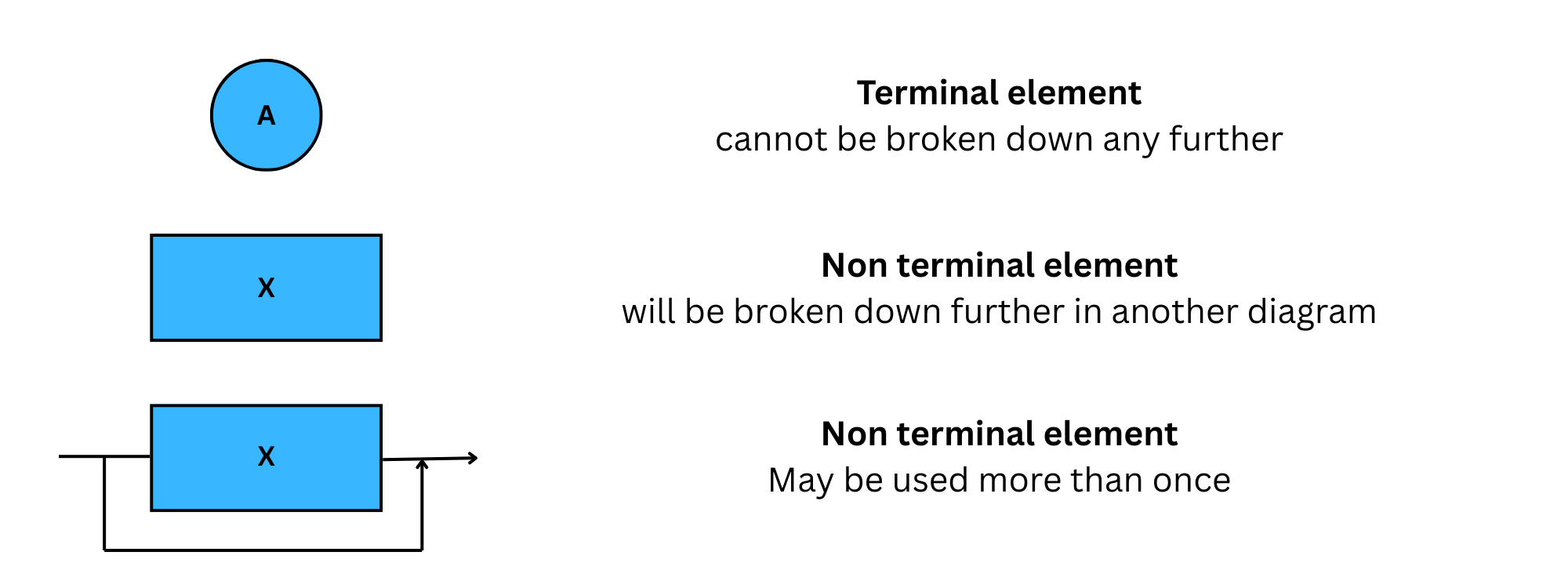
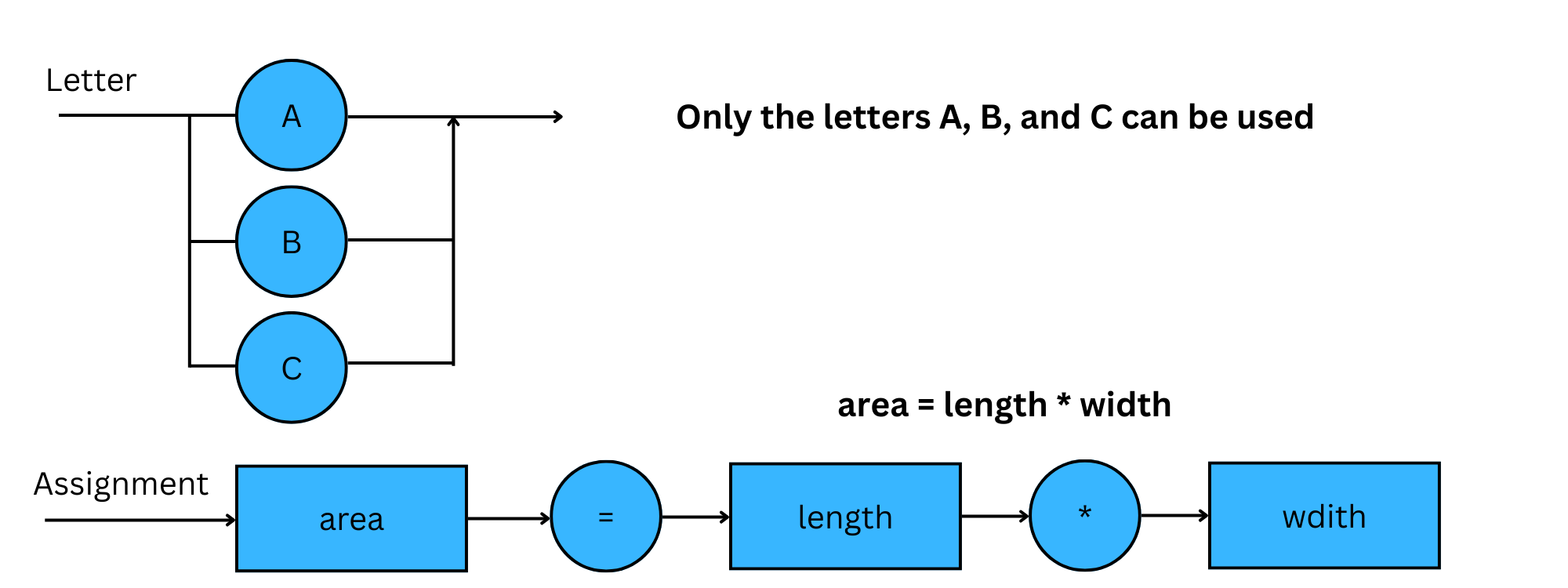
- A syntax diagram is a graphical representation of BNF (meta-language)
- It uses symbols to map directly to the structure of BNF
- The symbols used are:
Examples
Was this revision note helpful?
Build on this topic