11 markmedium
(d)
The final CASE condition (> 200) in the pseudocode example could be replaced with a keyword.
Give the keyword.
26 questions · 84 marks · ≈ 1 hours
The final CASE condition (> 200) in the pseudocode example could be replaced with a keyword.
Give the keyword.
One type of run-time error can cause a program to stop responding (‘freezing’).
Identify a particular type of programming construct that can generate this type of error and explain why it occurs.
Construct .......................................................................................................
Explanation.....................................................................................................
The function Process() contains a selection construct using a CASE structure.
Write pseudocode using a single selection construct with the same functionality without using a CASE structure.
Refer to the insert for the list of pseudocode functions and operators.
The following table contains pseudocode examples.
Each example may contain statements that relate to one or more of the following:
Complete the table by placing one or more ticks ('✓') in each row.
| Pseudocode example | Selection | Iteration | Subroutine |
|---|---|---|---|
FOR Index ← 1 TO 3 IF Safe[Index] = TRUE THEN Flap[Index] ← 0 ENDIFNEXT Index | |||
CASE OF Compound(3) | |||
REPEAT UNTIL AllDone() = TRUE | |||
WHILE Result[3] <> FALSE |
An algorithm will:
The algorithm requires the use of basic constructs. One of these is sequence.
Identify one other basic construct required by the algorithm and describe how it is used.
Construct....................................................................................................
Use..............................................................................................................
A global 1D array of strings contains three elements which are assigned values as shown:
Data[1] "aaaaaa"
Data[2] "bbbbbb"
Data [3] "cccccc"
ProcedureProcess()manipulates the values in the array.
The procedure is written in pseudocode as follows:
PROCEDURE Process(Format : STRING)
DECLARE Count, Index, L : INTEGER
DECLARE Result : STRING
DECLARE C : CHAR
Result"****"
FORCount 1 TO LENGTH(Format) STEP 2
CMID(Format, Count, 1)
LSTR_TO_NUM(MID(Format, Count + 1, 1))
Index (Count + 1) DIV 2
CASE OF C
'X' :Result TO_UPPER(Data[Index])
'Y' :Result TO_LOWER(Data[Index])
'Z' :Result "**" & Data[Index]
ENDCASE
Data[Index] LEFT(Result, L)
NEXT Count
ENDPROCEDURE
The procedure is to be modified. If variable C is assigned a value other than 'X', 'Y' or 'Z', then procedure Error() is called and passed the value of variable C as a parameter.
This modification can be implemented by adding a single line of pseudocode.
(i) Write the single line of pseudocode.
(1 mark)
(ii) State where this new line should be placed.
(1 mark)
A program is being designed in pseudocode.
The program contains a global 1D array Data of type string containing 200 elements.
The first element has the index value 1.
A procedure Process() is written to initialise the values in the array:
PROCEDURE Process(Label : STRING)
DECLARE Index : INTEGER
Index 0
INPUT Data[Index]
WHILE Index < 200
Index Index + 1
CASE OF (Index MOD 2)
0 : Data[Index] TO_UPPER(Label)
1 : Data[Index] TO_LOWER(Label)
OTHERWISE : OUTPUT "Alarm 1201"
ENDCASE
NEXT Index
OUTPUT "Completed " & Index & " times"
ENDPROCEDURE
equationThe procedure contains a statement that is not needed.
Identify the pseudocode statement and explain why it is not needed.
Statement ..........................................................................................
Explanation .........................................................................................
A program uses a global 1D array of type string and a text file.
An algorithm that forms part of the program is expressed as follows:
Sequence is one programming construct. Identify one other programming construct that will be required when the algorithm from part (a) is converted into pseudocode and explain its use.
Construct..........................................................................................................
Use....................................................................................................................
A record structure is declared to hold data relating to components being produced in a factory:
TYPE Component
DECLARE Item_ID : STRING
DECLARE Reject : BOOLEAN
DECLARE Weight : REAL
ENDTYPE
The factory normally produces a batch (or set) of 1000 components at a time. A global array is declared to store 1000 records for a batch:
DECLARE Batch : ARRAY [1:1000] OF Component
Two global variables contain the minimum and maximum acceptable weight for each component. The values represent an inclusive range and are declared as:
DECLARE Min, Max : REAL
A program uses a variable ThisIndex as the array index to access a record.
Write a pseudocode clause to check whether or not the weight of an individual component is within the acceptable range.
A program is being designed in pseudocode.
The program contains the following declaration:
DECLARE Data : ARRAY[1:1000] OF STRING
A procedure ArrayInitialise() is written to initialise the values in the array:
PROCEDURE ArrayInitialise(Label : STRING)
DECLARE Index : INTEGER
Index1
WHILE Index <= 1000
CASE OF (Index MOD 2)
0 : Data[Index]FormatA(Label)
IndexIndex + 1
1 : Data[Index]FormatB(Label)
IndexIndex + 1
ENDCASE
ENDWHILE
ENDPROCEDURE
Functions FormatA() and FormatB() apply fixed format case changes to the parameter string.
The design of the procedure does not use the most appropriate loop construct.
Suggest a more appropriate construct that could be used and explain your choice.
Construct ........................................................................................................
Explanation ......................................................................................................
Refer to the insert for the list of pseudocode functions and operators.
The following pseudocode represents part of the algorithm for a program:
CASE OF ThisValue
< 30 : Level "Low" // less than 30
Check 1
< 20 : Level "Very Low" // less than 20
Check ThisValue / 2
30 TO 40 : Level"Medium" // between 30 and 40
CheckThisValue / 3
Data[ThisValue] Data[ThisValue] + 1
> 40 : Level "High"
ENDCASE
Complete the table by writing the answer for each row:
| Answer | |
|---|---|
The value assigned to Level when ThisValue is 40 | |
The value assigned to Check when ThisValue is 36 | |
The value assigned to Level when ThisValue is 18 | |
The number of elements in array Data that may be incremented |
The pseudocode contains four assignments to variable Level. One of these assignments will never be performed.
Identify this assignment and explain why this is the case.
The following line is added immediately before the ENDCASE statement:
OTHERWISE : Level "Undefined"
State why this assignment is never performed.
Sequence is one programming construct.
Identify two other programming constructs that will be required when the algorithm is converted into pseudocode.
Construct 1 ..........................................................................................................
Construct 2 .........................................................................................................
An algorithm will:
The solution to the algorithm includes iteration.
Give the name of a suitable loop structure that could be used.
Justify your answer.
Name .....................................................................................................................
Justification ............................................................................................................
A program contains six modules:
| Pseudocode module header |
|---|
PROCEDURE Module-A() |
PROCEDURE Module-X(T1 : INTEGER, S2 : REAL) |
PROCEDURE Reset(BYREF Code : INTEGER) |
FUNCTION Restore(OldCode : INTEGER) RETURNS BOOLEAN |
FUNCTION Module-Y(RA : INTEGER, RB : BOOLEAN) RETURNS BOOLEAN |
FUNCTION Module-Z(SA : INTEGER) RETURNS INTEGER |
Module-X() calls Reset()
Module-Y() calls Restore()
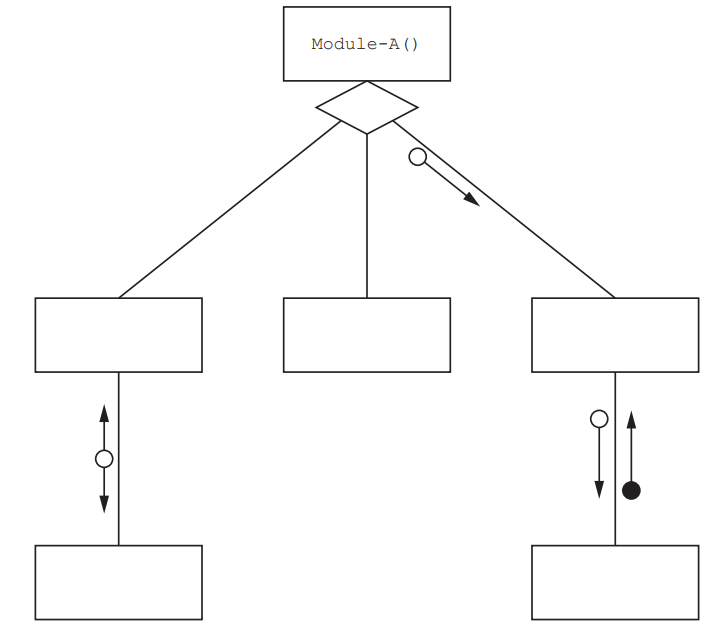
Explain the meaning of the diamond symbol as used in the diagram in part (a).
A global 1D array of integers contains four elements, which are assigned values as shown:
Mix[1] 4
Mix[2]2
Mix[3]3
Mix[4]5
A procedure Process() manipulates the values in the array.
The procedure is written in pseudocode as follows:
PROCEDURE Process(Start : INTEGER)
DECLARE Value, Index, Total : INTEGER
IndexStart
Total0
WHILE Total < 20
ValueMix[Index]
TotalTotal + Value
IF Index < 4 THEN
Mix[Index]Mix[Index] + Mix[Index+1]
ELSE
Mix[Index]Mix[Index] + Mix[1]
ENDIF
Index(Value MOD 4) + 1
ENDWHILE
Mix[1]Total * Index
ENDPROCEDURE
Complete the trace table on the opposite page by dry running the procedure when it is called as follows:
CALL Process(2)
| Index | Value | Total | Mix[1] | Mix[2] | Mix[3] | Mix[4] |
|---|---|---|---|---|---|---|
A security program controls the door of a laboratory.
The variable CardValid is of type BOOLEAN and has already been assigned a value.
Part of the program is written in pseudocode as follows.
The pseudocode contains a logical error.
Identify the error and suggest a correction.
A weather station has a program that decides whether visitors may enter.
The program has already input two variables:
WindSpeed, of type INTEGER, holding the wind speed in kilometres per hourVisibility, of type INTEGER, holding the visibility in metresThe program must output exactly one message, chosen as follows.
"Station closed"."Restricted access"."Station open".Write the pseudocode selection statement for this.
You must use nested IF statements.
A shop records the number of items sold on each of the 14 days of a sales period. The values are held in a global array that is declared as follows.
The following pseudocode adds together all the values in the array and outputs the total.
Complete the pseudocode by writing the missing part at each of the two gaps.
A courier company works out the cost of sending one parcel.
The mass of a parcel may have a fractional part, for example 12.4 kilograms.
A program will:
"Parcel refused" if the mass is greater than 30, and work out no cost"International"The program handles one parcel only.
Write pseudocode for the program.
You must declare all variables used.
A program contains the following pseudocode.
Complete the table by writing the answer for each row.
| Statement | Answer |
|---|---|
The number of times the statement Total ← Total + Position is executed | |
The last value taken by Position inside the loop | |
| The value that is output |
A college converts an examination mark into an award. Marks are whole numbers from 0 to 100.
| Mark | Award |
|---|---|
| 0 to 49 | Fail |
| 50 to 69 | Pass |
| 70 to 89 | Merit |
| 90 to 100 | Distinction |
Part of the program is written in pseudocode as follows. Two clause values are missing.
Complete the pseudocode by writing the two missing clause values.
A hotel stores the number of bookings it took last year. The data is held in a global two-dimensional array that is declared as follows.
The first index is the month number, from 1 to 12. The second index is the room type, from 1 to 4.
For example, Bookings[3, 2] holds the number of bookings taken in month 3 for room type 2.
A procedure MonthTotals() will output, for each month in turn, the month number followed by the total number of bookings taken in that month across all four room types. The procedure produces 12 lines of output.
Write pseudocode for the procedure MonthTotals().
You must declare all local variables that you use.
A robot moves along a single track in a warehouse. An operator types one character at a time to control it.
The program stores the character in a variable Command of type CHAR. Three global variables have already been declared and given values:
Position, of type INTEGERMoving, of type BOOLEANErrors, of type INTEGERThe program must respond to Command as follows.
| Command | Action |
|---|---|
| F | add 1 to Position |
| B | subtract 1 from Position |
| H | set Moving to FALSE and set Position to 0 |
| any other character | add 1 to Errors |
Write a CASE structure for this.
A warehouse program counts how many full packs of 10 items can be made from a quantity of loose items.
State the value that is output in each of the following two cases.
Case 1: the value 35 is input.
Case 2: the value 7 is input.
A shop gives every product a four-digit code, which is stored in an integer variable Code. Every code is in the range 1000 to 9999.
The first digit of the code identifies the department.
| First digit | Department |
|---|---|
| 1 | Books |
| 2 | Music |
| 3 | Films |
| 4 to 9 | Warehouse |
A variable Dept of type STRING has already been declared.
Write a CASE structure that assigns the correct department name to Dept.
An operator enters temperature readings into a program. A reading is accepted only if it is a whole number from -40 to 60 inclusive.
The program must:
Complete the pseudocode by writing the missing part at each of the three gaps.
A biology program models the growth of a colony of cells. The number of cells doubles once every hour.
A function HoursToReach() will:
If the starting number of cells is already greater than the target, the function returns 0.
Assume the starting number of cells is always 1 or more.
For example, HoursToReach(1, 10) returns 4, because the colony grows 1, 2, 4, 8, 16 and 16 is the first value greater than 10.
Write pseudocode for the function HoursToReach().
You must declare all local variables that you use, and you must use a conditional loop.