The Role of Telomeres (Cambridge International A-Level Biology)
The Significance of Telomeres
Spec point — outline the role of telomeres in preventing the loss of genes from the ends of chromosomes during DNA replication
-
The ends of the chromatids in chromosomes are ‘sealed’ with protective structures called telomeres
- They are made of non-coding DNA (DNA that does not contain genes) that is made up of short base sequences that are repeated many times (multiple repeat sequences)
-
The main function of telomeres is to ensure that the very ends of the DNA molecules are included when the DNA is replicated in the S phase of interphase, before the cell divides by mitosis
- This is because the copying enzyme responsible for DNA replication is unable to run right to the very end of the DNA molecule and stops a little short of the end
- If this end part of the DNA molecule contained an important gene, that piece of genetic information would be lost during DNA replication
- In each subsequent cell division, a little more genetic information would be lost
-
Telomeres therefore act as a ‘buffer’ region of non-essential DNA
- They ensure that no important coding sections near the ends of the DNA molecules are left out of the replication process
- This ensures no genes are lost during cell division (the loss of vital genes can even result in cell death) and allows for continued replication of a cell
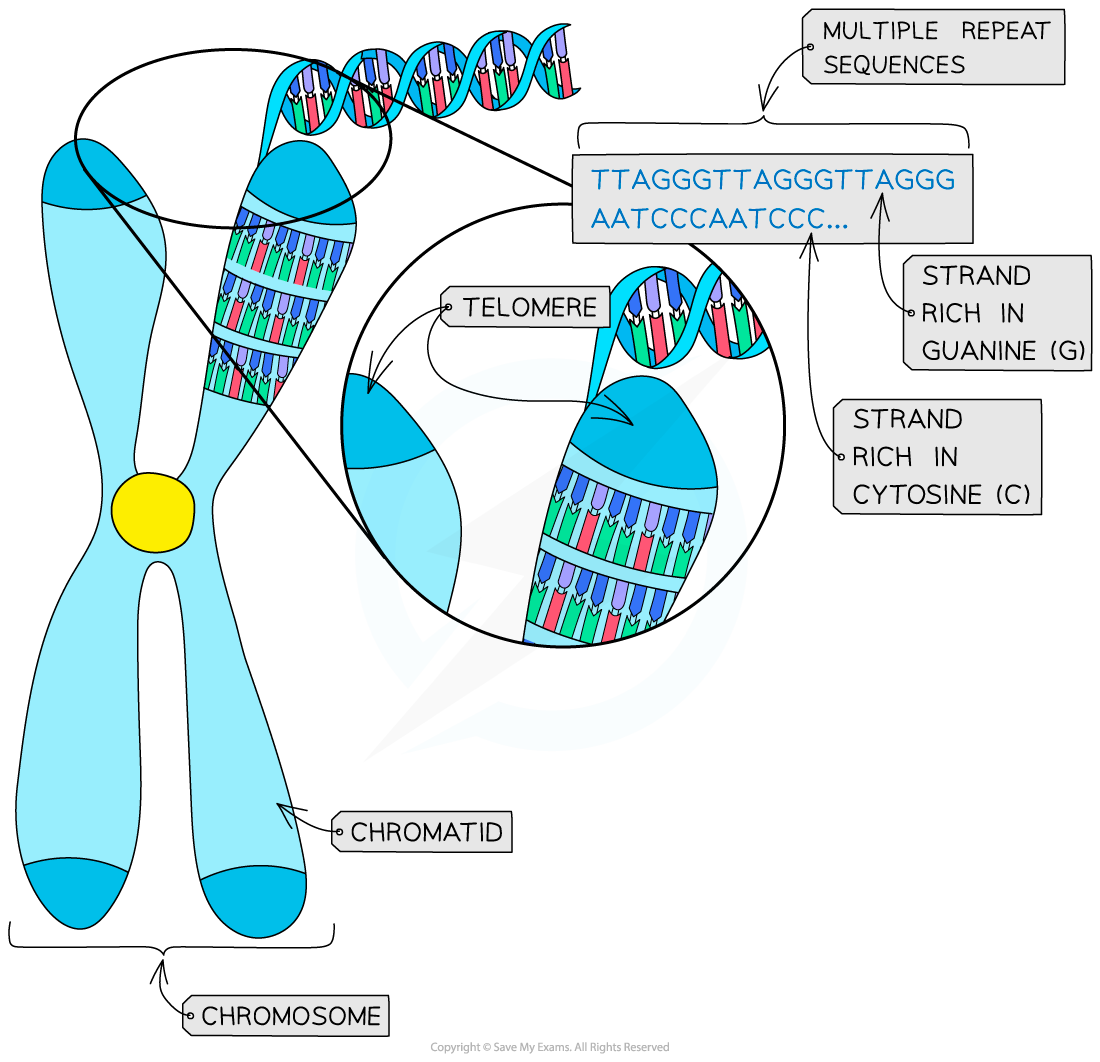
A telomere with multiple repeat sequences
Exam Hint Telomeres are similar to the coding regions of DNA molecules in that they are made of the same nucleotides. However, telomeres' base sequences are non-coding, meaning they do not code for proteins.
Was this revision note helpful?