The Structure of DNA (Cambridge International A-Level Biology)
DNA Structure
Spec point — describe the structure of a DNA molecule as a double helix, including: • the importance of complementary base pairing between the ′ to ′ strand and the ′ to ′ strand (antiparallel strands) • differences in hydrogen bonding between C–G and A–T base pairs • linking of nucleotides by phosphodiester bonds
DNA structure
- The nucleic acid DNA is a polynucleotide—it is made up of many nucleotides bonded together in a long chain
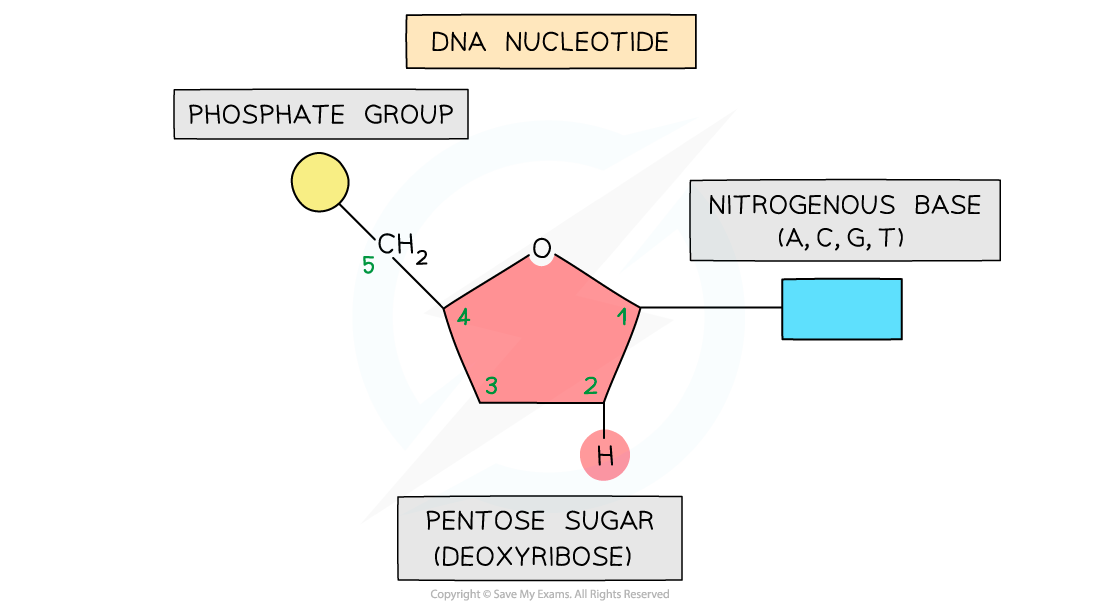
A DNA nucleotide
-
DNA molecules are made up of two polynucleotide strands lying side by side, running in opposite directions
- The strands are said to be antiparallel
-
Each DNA polynucleotide strand is made up of alternating deoxyribose sugars and phosphate groups bonded together to form the sugar-phosphate backbone
-
These bonds are covalent bonds known as phosphodiester bonds
- The phosphodiester bonds link the 5-carbon of one deoxyribose sugar molecule to the phosphate group from the same nucleotide
- The phosphate group is linked by another phosphodiester bond to the 3-carbon of the deoxyribose sugar molecule of the next nucleotide in the strand
- Each DNA polynucleotide strand is said to have a 3’ end and a 5’ end (these numbers relate to which carbon on the pentose sugar could be bonded with another nucleotide)
- As the strands run in opposite directions (they are antiparallel), one is known as the 5’ to 3’ strand and the other is known as the 3’ to 5’ strand
-
The nitrogenous bases of each nucleotide project out from the backbone towards the interior of the double-stranded DNA molecule
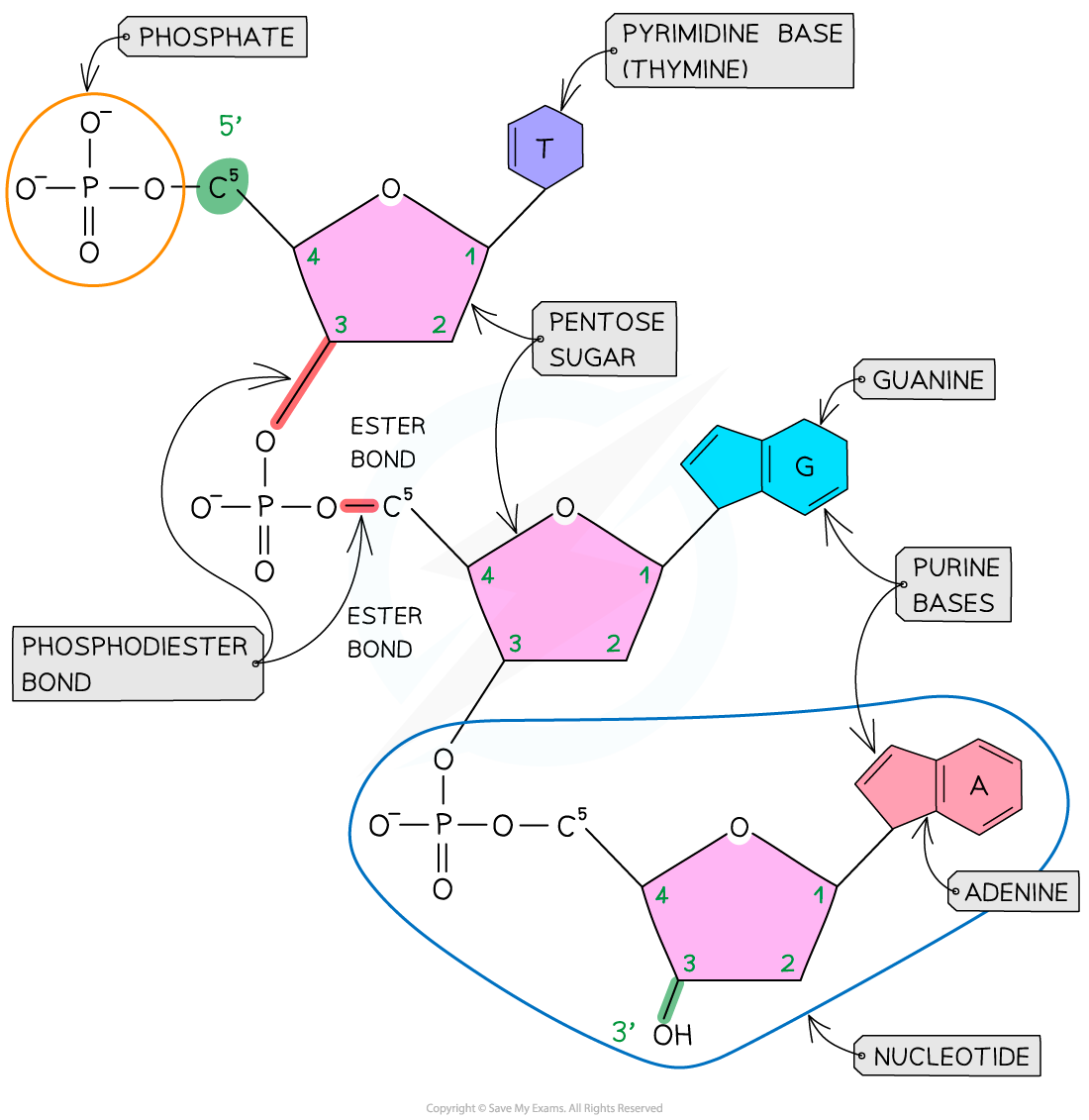
A single DNA polynucleotide strand showing the positioning of the ester bonds
Hydrogen bonding
-
The two antiparallel DNA polynucleotide strands that make up the DNA molecule are held together by hydrogen bonds between the nitrogenous bases
-
These hydrogen bonds always occur between the same pairs of bases:
-
The purine adenine (A) always pairs with the pyrimidine thymine (T)
- Two hydrogen bonds are formed between these bases
-
The purine guanine (G) always pairs with the pyrimidine cytosine (C)
- Three hydrogen bonds are formed between these bases
-
This is known as complementary base pairing
-
These pairs are known as DNA base pairs
-
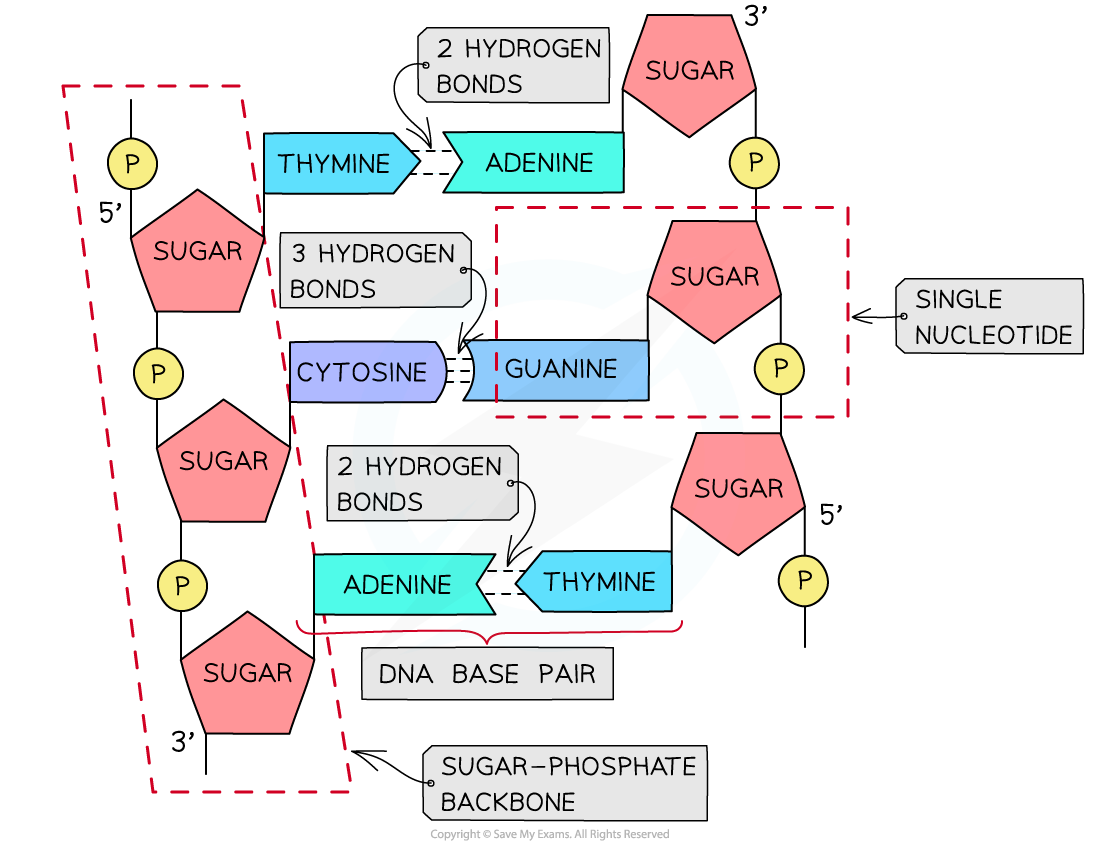
A section of DNA—two antiparallel DNA polynucleotide strands held together by hydrogen bonds
Double helix
- DNA is not two-dimensional as seen in the diagram above
- DNA is described as a double helix
- This refers to the three-dimensional shape that DNA molecules form
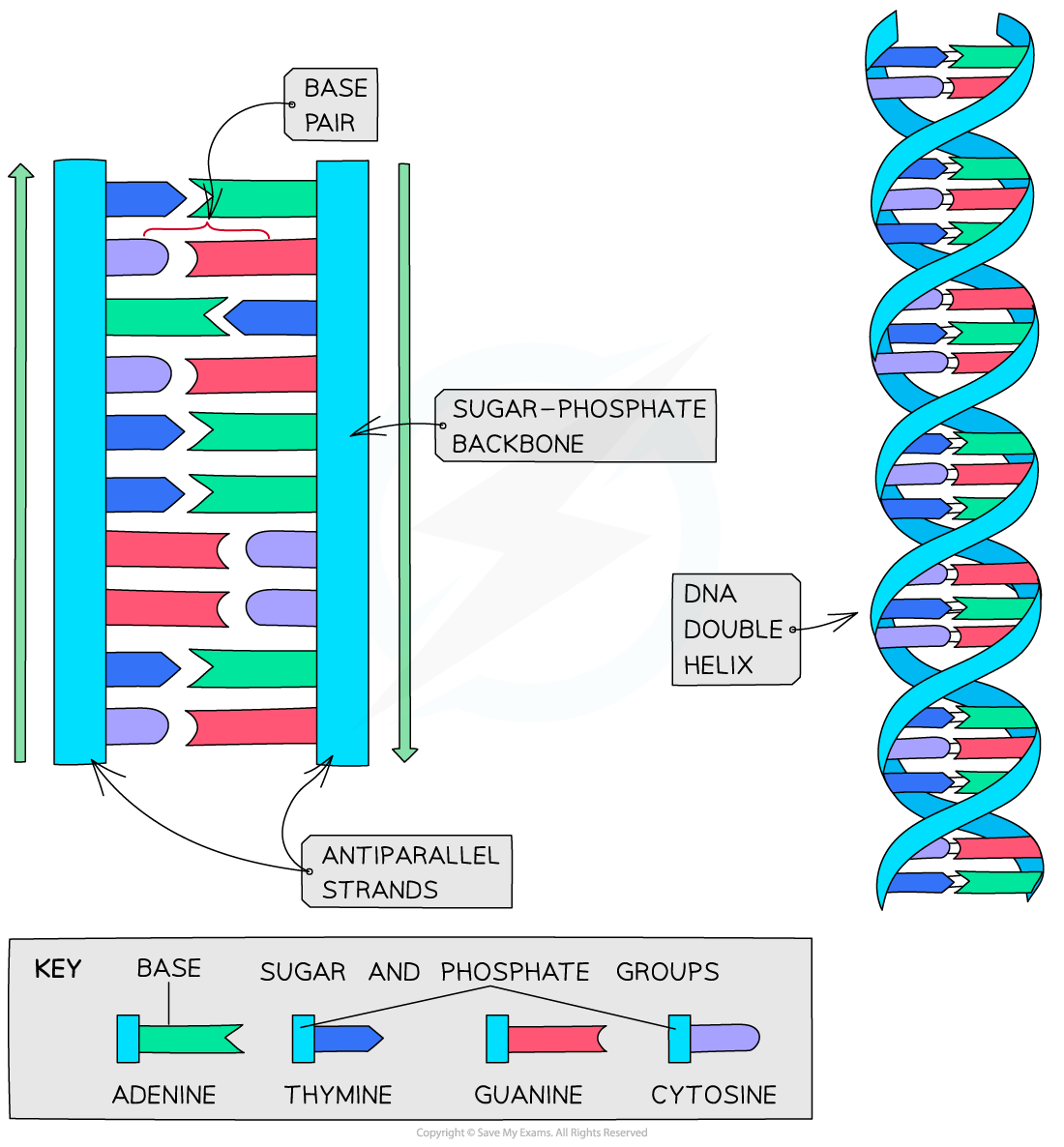
DNA molecules form a three-dimensional structure known as a DNA double helix
Exam Hint Make sure you can:
- Name the different components of a DNA molecule (sugar-phosphate backbone, nucleotide, complementary base pairs, phosphodiester bonds, hydrogen bonds)
- Locate these on a diagram
You must know how many hydrogen bonds occur between the different base pairs.
Remember that the bases are complementary so the number of A = the number of T and the number of C = the number of G.
You could be asked to determine how many bases are present in a DNA molecule if given the number of one of the bases.
Was this revision note helpful?
Build on this topic