Investigating Surface Area (Cambridge International A-Level Biology)
Investigating SA with Agar
Spec point — investigate the effect of changing surface area to volume ratio on diffusion using agar blocks of different sizes
- The effect of changing surface area to volume ratio on diffusion can be investigated by timing the diffusion of ions through cubes of agar of different sizes
Method
-
Coloured agar is made up and cut into cubes of the required dimensions (eg. 0.5 cm × 0.5 cm × 0.5 cm, 1 cm × 1 cm × 1 cm and 2 cm × 2 cm × 2 cm)
-
The surface area, volume and surface area to volume ratio of these cubes is calculated and recorded
-
The cubes are then placed into boiling tubes containing a diffusion solution (such as dilute hydrochloric acid)
- The same volume of dilute hydrochloric acid should be measured carefully into each boiling tube
- The acid should have higher concentration than the sodium hydroxide so that its diffusion can be monitored by a change in colour of the indicator in the agar blocks
-
Measurements can be taken of either:
- The time taken for the acid to completely change the colour of the indicator in the agar blocks
- The distance travelled into the block by the acid (shown by the change in colour of the indicator) in a given time (e.g., 5 minutes)
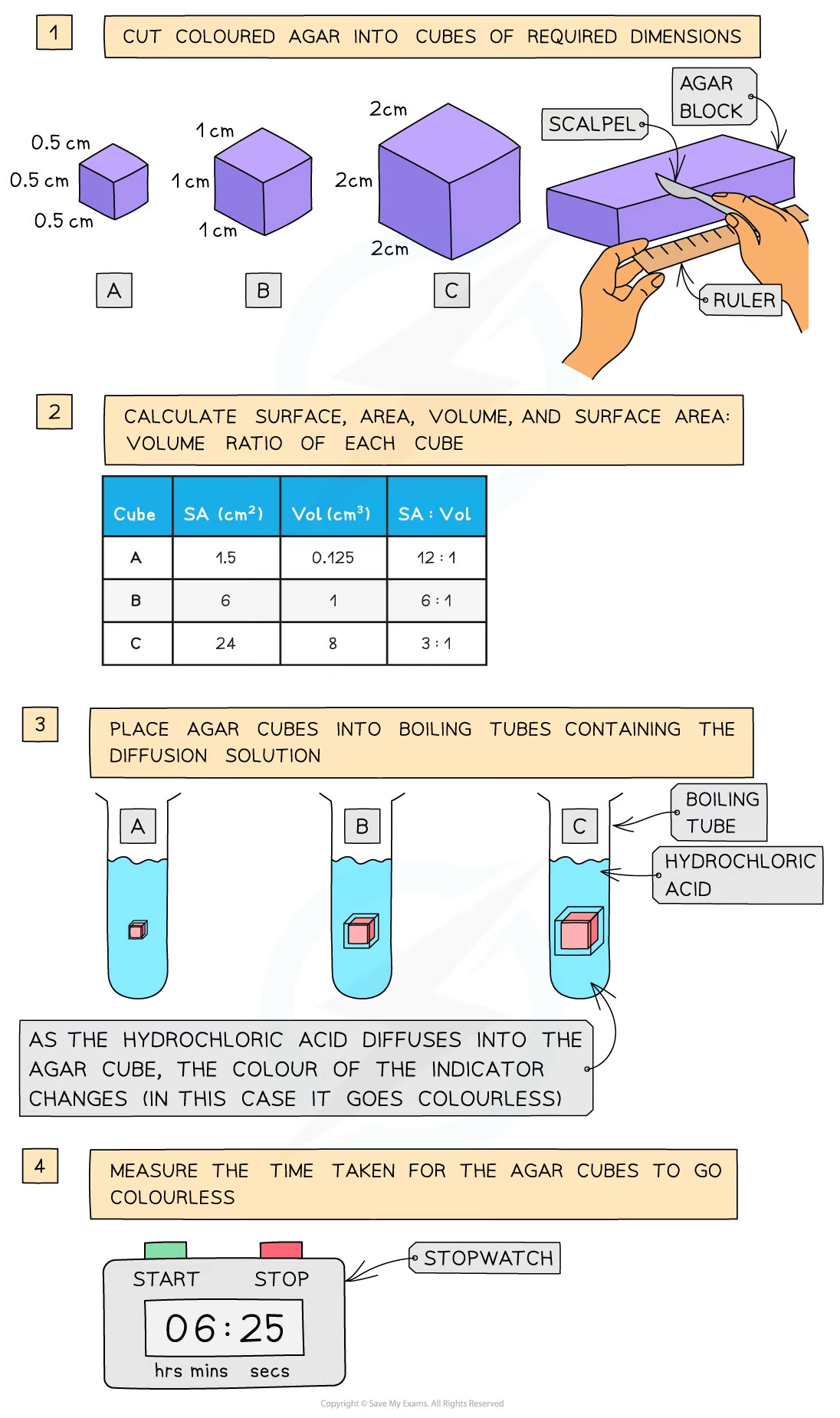
The steps used to investigate the effect of changing the surface area to volume ratio on diffusion
Analysis
- If the time taken for the acid to completely change the colour of the indicator in the agar blocks is recorded, these times can be converted to rates
- A graph could be plotted showing how the rate of diffusion (rate of colour change) changes with the surface area : volume ratio of the agar cubes
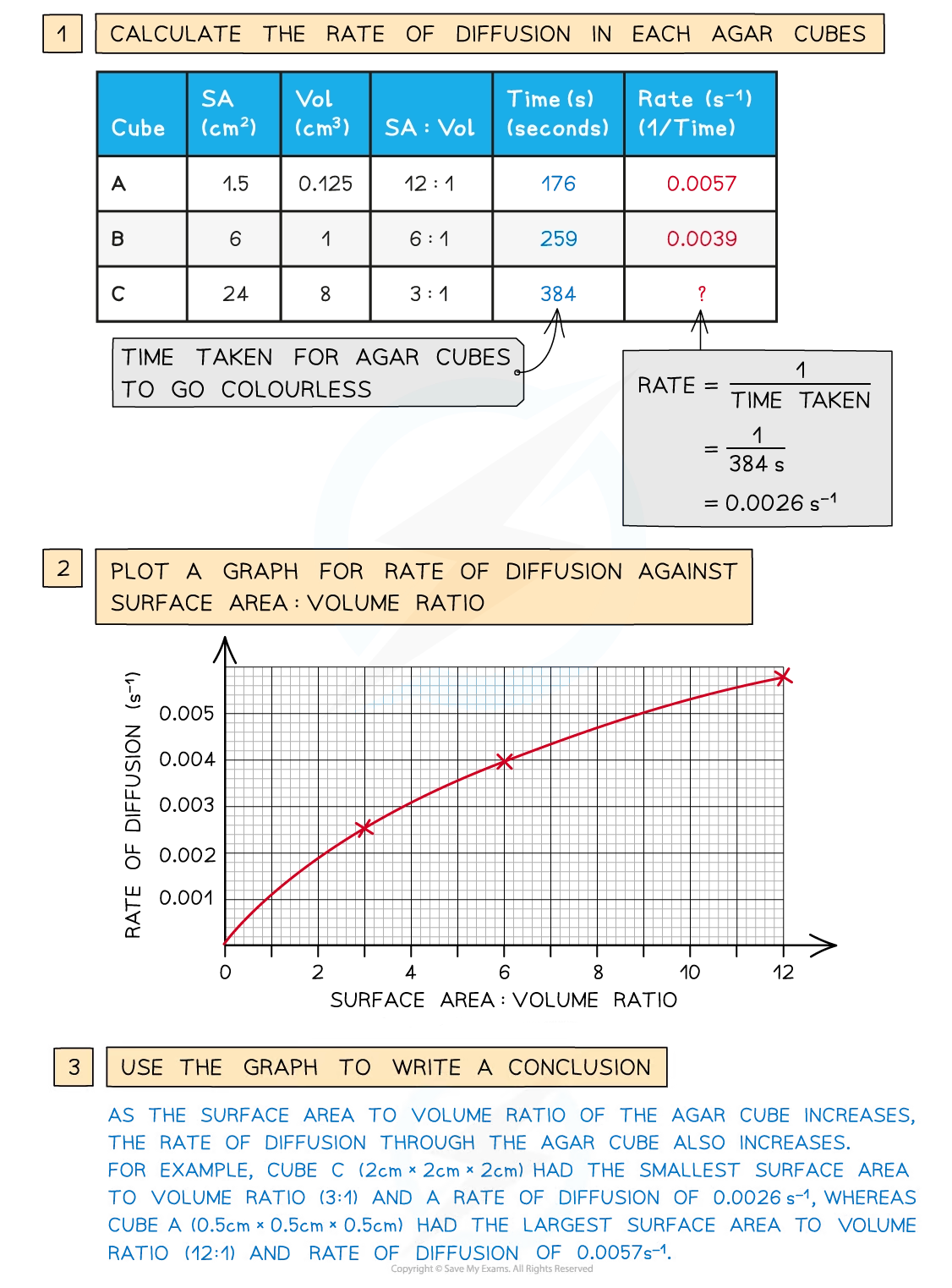
To analyse the results of the investigation, calculate the rates of diffusion before plotting a graph for rate of diffusion against surface area : volume ratio
Was this revision note helpful?
Build on this topic