Colorimetry (Cambridge International A-Level Biology)
Colorimetry to Measure Enzyme Activity
Spec point —
3.1.4· outline the use of a colorimeter for measuring the progress of enzyme-catalysed reactions that involve colour changes
-
A colorimeter is able to measure light absorbance (how much light is absorbed) or **light transmission **(how much light passes through) a substance
-
Colorimetry can be used in any enzyme-catalysed reaction that involves** colour change**
-
As the colour breaks down the transmission increases or light absorption decreases and this can be used to measure the rate of the reaction
-
For example, a colorimeter can be used to follow the progress of a starch-amylase catalysed reaction as the amylase breaks the starch down into maltose
-
This can be carried out as follows:
- Colorimeter calibration: this is an important step in a colorimetric investigation and in this case a weak iodine solution can be used to calibrate the colorimeter as the end point (or 100% transmission)
- Preparation of a starch solution of known concentration (stock solution), from which a range of concentrations are made using serial dilutions (method outlined in diagram below)
- Following calibration and switching on the red filter (a colour the blue-black starch-iodine solution absorbs strongly, so absorbance changes most with starch concentration), the colorimeter is used to measure the percentage absorbance or percentage transmission values
- A calibration graph is then plotted of starch concentration (X-axis) vs percentage absorbance or percentage transmission (Y-axis)
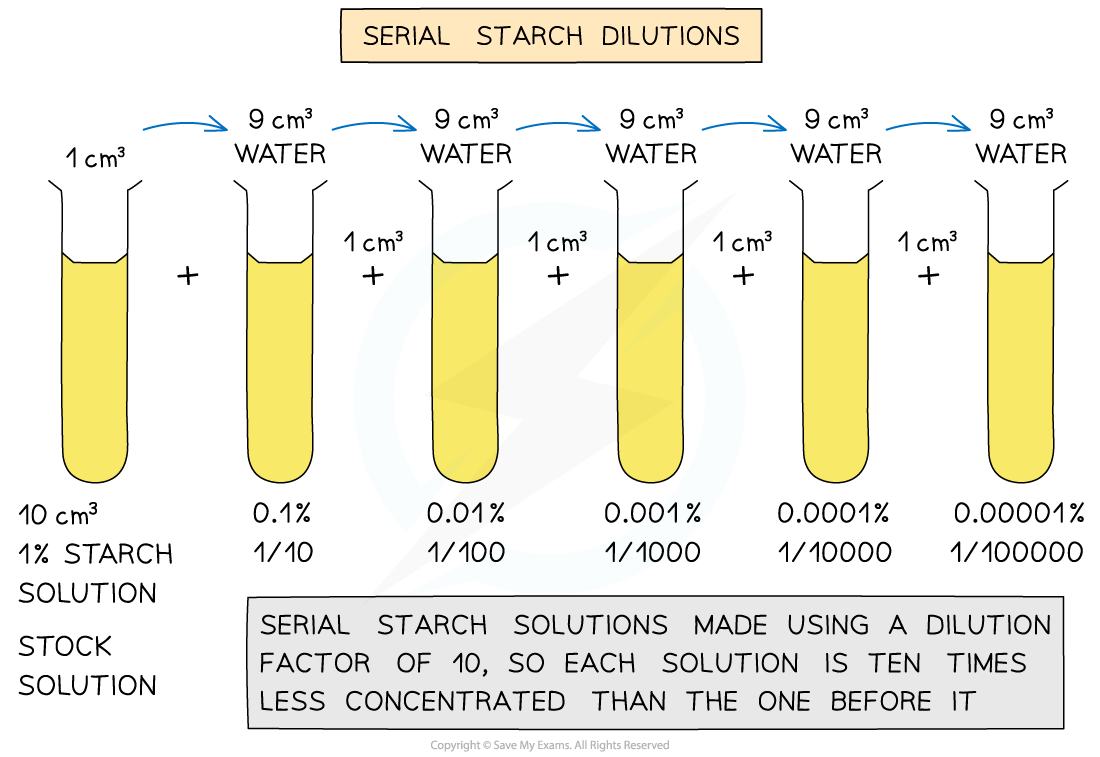
Serial dilution of starch to make a range of concentrations
Exam Hint Always calibrate the colorimeter with a blank before taking any measurements.
If you skip this, the readings won’t be accurate because the colorimeter won’t be zeroed. Examiners may award a specific mark for stating that a blank (such as distilled water or weak iodine solution) must be used to set the absorbance to 0 before testing your samples.
Was this revision note helpful?
Build on this topic