Cell Signalling (Cambridge International A-Level Biology)
Spec point —
4.1.4· "outline the main stages in the process of cell signalling leading to specific responses: • secretion of specific chemicals (ligands) from cells • transport of ligands to target cells • binding of ligands to cell surface receptors on target cells"
Cell signalling
-
Cell signalling is the process by which messages are sent to cells
-
Cell signalling is very important as it allows multicellular organisms to control / coordinate their bodies and respond to their environments
-
Cell signalling pathways coordinate the activities of cells, even if they are large distances apart within the organism
-
The basic stages of a cell signalling pathway are:
- A stimulus or signal is received by a receptor
- The signal is converted to a ‘message’ that can be passed on – this process is known as transduction
- The ‘message’ is transmitted to a target (effector)
- An appropriate response is made
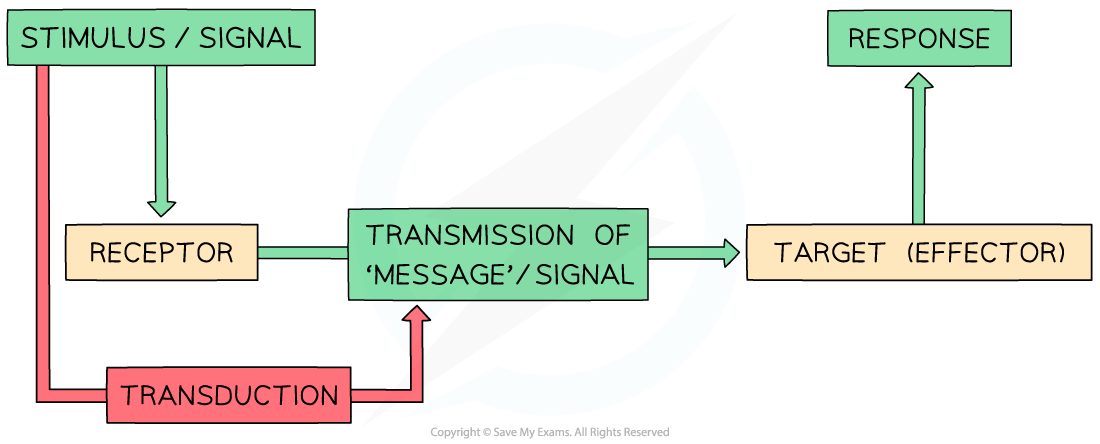
The basic stages of a cell signalling pathway
- Transmission of messages in cell signalling pathways requires crossing barriers such as cell surface membranes
- Cell surface membranes are therefore very important in signalling pathways because the membrane controls which molecules (including cell signalling molecules) can move between the internal and external environments of the cell
- Many signalling molecules (ligands) do not enter the target cell; they bind to specific receptors on the cell surface membrane
- Typically in cell signalling pathways, signalling molecules need to cross or interact with cell membranes
Ligands
-
Signalling molecules are often called ligands
-
Ligands are involved in the following stages of a cell signalling pathway:
-
Ligands are secreted from a cell (the sending cell) into the extracellular space
-
The ligands are then transported through the extracellular space to the target cell
-
The ligands bind to surface receptors (specific to that ligand) on the target cell
- These receptors are formed from glycolipids and glycoproteins
-
The message carried by the ligand is relayed through a chain of chemical messengers inside the cell, triggering a response
-
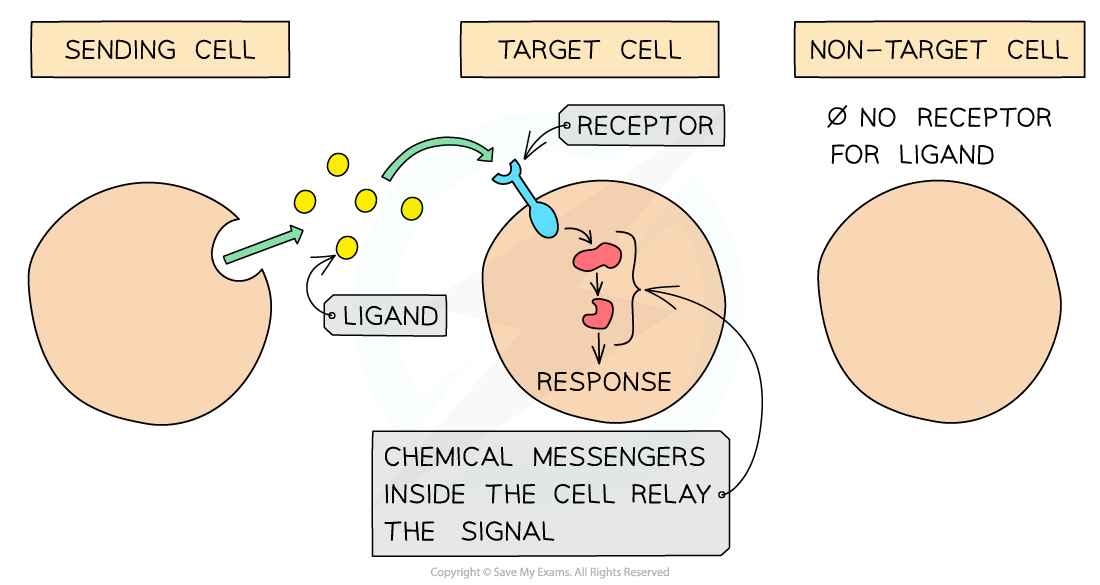
The role of ligands in a cell signalling pathway
Was this revision note helpful?
Build on this topic