Types of Immunity (Cambridge International A-Level Biology)
Spec point —
11.2.4· describe the differences between active immunity and passive immunity and between natural immunity and artificial immunity
Types of immunity
Active immunity
-
Active immunity is acquired when an antigen enters the body triggering a specific immune response (antibodies are produced)
-
Active immunity can be:
- Naturally acquired through exposure to microbes
- Artificially acquired through vaccinations
-
The body produces memory cells, along with plasma cells, in both types of active immunity
- This gives the person long-term immunity
-
In active immunity, during the primary response to a pathogen (natural) or to a vaccination (artificial), the antibody concentration in the blood takes one to two weeks to increase.
-
If the body is invaded by the same pathogen again or by the pathogen that the person was vaccinated against then, during the secondary response, the antibody concentration in the blood:
- Takes a much shorter period of time to increase
- Is higher than after the vaccination or first infection
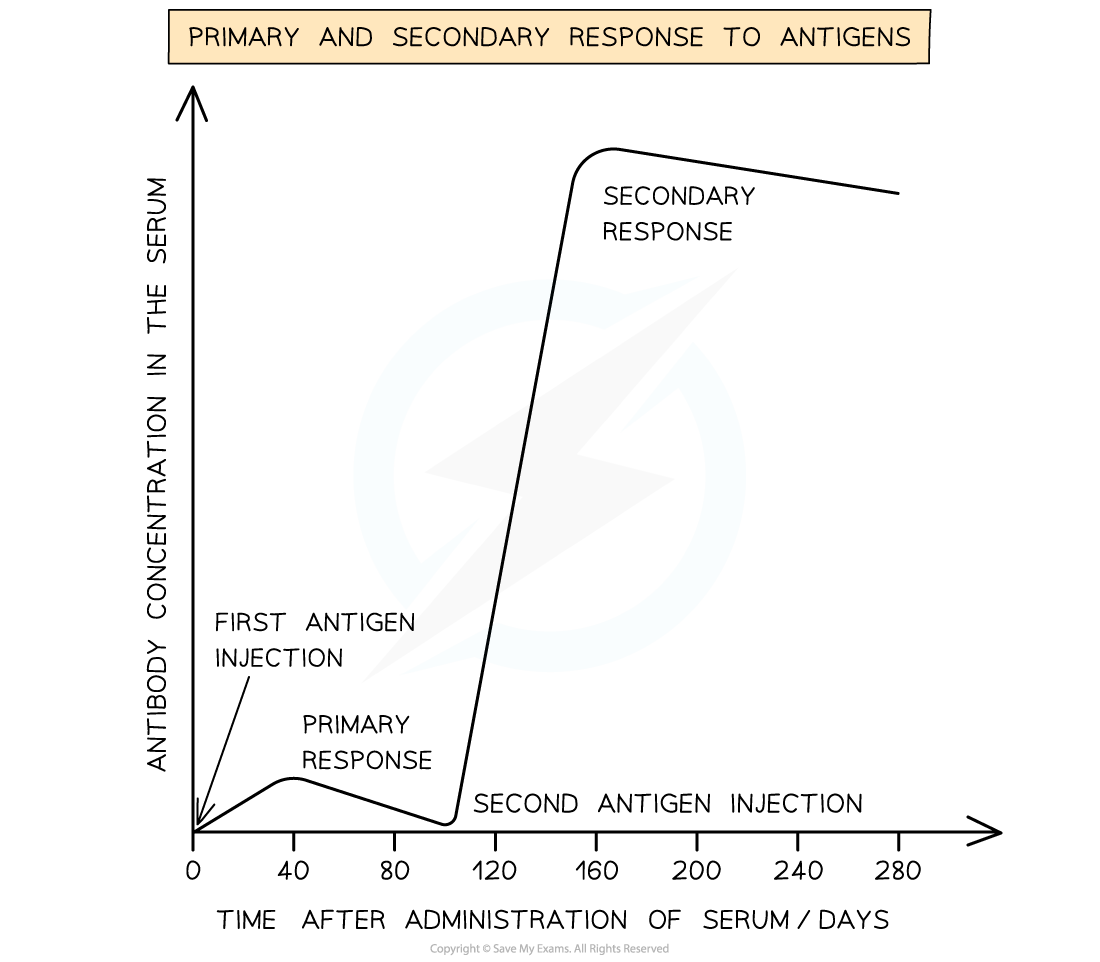
The primary and secondary response to the same antigen
Passive immunity
-
Passive immunity is acquired without an immune response
- Antibodies are not produced by the infected person
-
As the person’s immune system has not been activated, there are no memory cells that can produce antibodies in a secondary response
- If a person is reinfected they would need another infusion of antibodies
-
Depending on the disease a person is infected with (e.g., tetanus) they may not have time to actively acquire the immunity (there is no time for active immunity to occur)
-
Passive immunity occurs either artificially or naturally
-
Artificial passive immunity occurs when:
- People are given an injection / transfusion of the antibodies—in the case of tetanus this is an antitoxin
- The antibodies were collected from people whose immune system had been triggered by a vaccination to produce tetanus antibodies
-
Natural passive immunity occurs when:
- Foetuses receive antibodies across the placenta from their mothers
- Babies receive the initial breast milk from mothers (the colostrum) which delivers a certain type of antibody (IgA)
-
| Feature | Active | Passive |
|---|---|---|
| Production of antibodies | Produced by the body | Not produced by the body |
| Time before antibodies appear in the blood | 1-2 weeks | Immediate |
| Presence of memory cells | Yes | No |
| Induced naturally by: | Exposure to pathogen | Antibodies received from another organism (e.g. via the placenta during pregnancy) |
| Induced artificially by: | Vaccination | Antibodies are manufactured and injected / infused into the body (e.g. monoclonal antibodies given by injection or infusion) |
Exam Hint Active immunity is when the body produces the antibodies, whereas in passive immunity the body is given the antibodies.
Was this revision note helpful?
Build on this topic