Resolution & Magnification (Cambridge International A-Level Biology)
Spec point —
1.1.5· define resolution and magnification and explain the differences between these terms, with reference to light microscopy and electron microscopy
Resolution & magnification
Magnification
-
Magnification is the number of times that a real-life specimen has been enlarged to give a larger view/image
- E.g. a magnification of x100 means that a specimen has been enlarged 100 times to give the image shown
-
A light microscope has two types of lens which allow it to achieve different levels of magnification:
- An eyepiece lens, which often has a magnification of x10
- A series of objective lenses, each with a different magnification, e.g. x4, x10, x40 and x100
-
To calculate the total magnification of a specimen being viewed, the magnification of the eyepiece lens and the objective lens are multiplied together:
Total magnification = eyepiece lens magnification x objective lens magnification
Resolution
-
Resolution is the ability of a microscope to distinguish two points that are close together as separate objects; it determines how much detail can be seen
- If resolution is too low, two separate objects appear as one point and the image looks blurry
-
Resolution limits useful magnification; increasing magnification beyond this does not reveal more detail
-
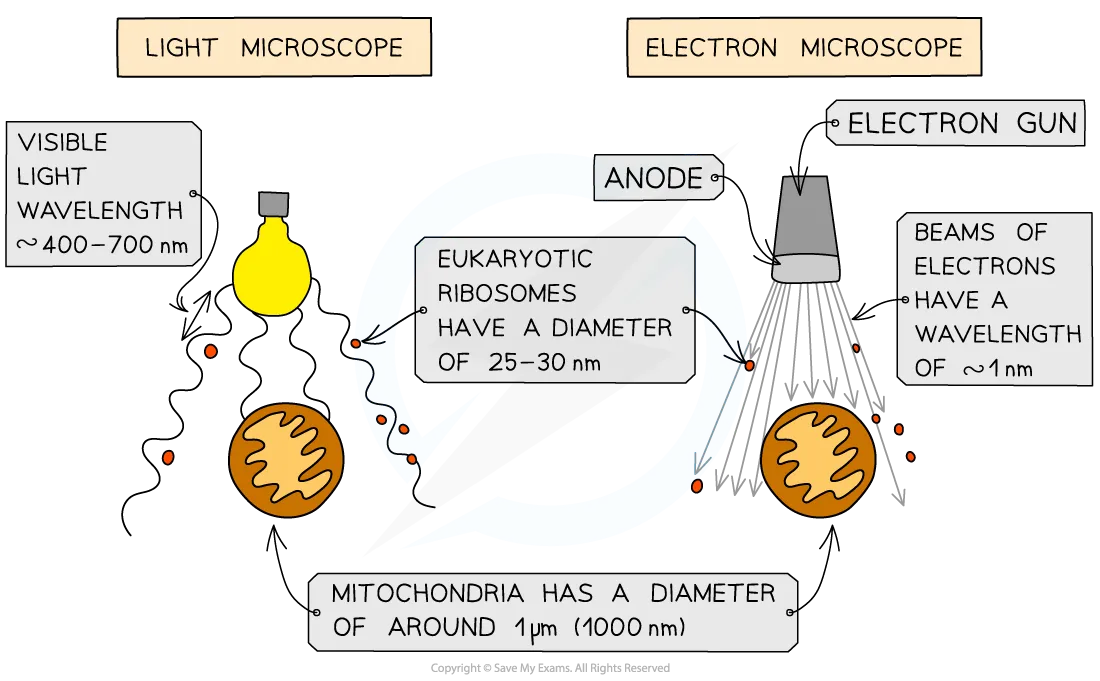
The resolution of a light microscope is limited by the wavelength of light
- It cannot resolve points closer together than about half the wavelength of visible light (400–700 nm)
- The shortest wavelength is 400 nm, so the resolution limit of a light microscope is about 200 nm
- E.g. a phospholipid bilayer is about 7 nm wide, well below 200 nm, so its structure cannot be seen with a light microscope
-
Electron microscopes have a much higher resolution than light microscopes because electrons have a much smaller wavelength than visible light
- They can achieve a resolution of about 0.5 nm, so they can usefully magnify much more
Exam Hint Don’t assume that increasing magnification will let you see more detail — it won’t if the resolution is too low.
Remember: magnification makes things bigger, resolution makes things clearer.
Was this revision note helpful?
Build on this topic