Neurones (Cambridge International A-Level Biology)
Spec point —
15.1.3· describe the structure and function of a sensory neurone and a motor neurone and state that intermediate neurones connect sensory neurones and motor neurones
Neurones
-
A neurones has a long fibre known as an axon
-
The axon is insulated by a fatty sheath with small, uninsulated sections along its length (called nodes of Ranvier)
- The sheath is made of myelin, a substance that is made by specialised cells known as Schwann cells
- Myelin is made when Schwann cells wrap themselves around the axon along its length
-
This means that action potentials do not occur along the whole axon; instead the action potential jumps from one node of Ranvier to the next
-
This means the impulse travels along the axon much faster than along an unmyelinated axon (saltatory conduction)
-
Their cell bodies contain many extensions called dendrites
- This means they can connect to many other neurones and receive impulses from them, forming a network for easy communication
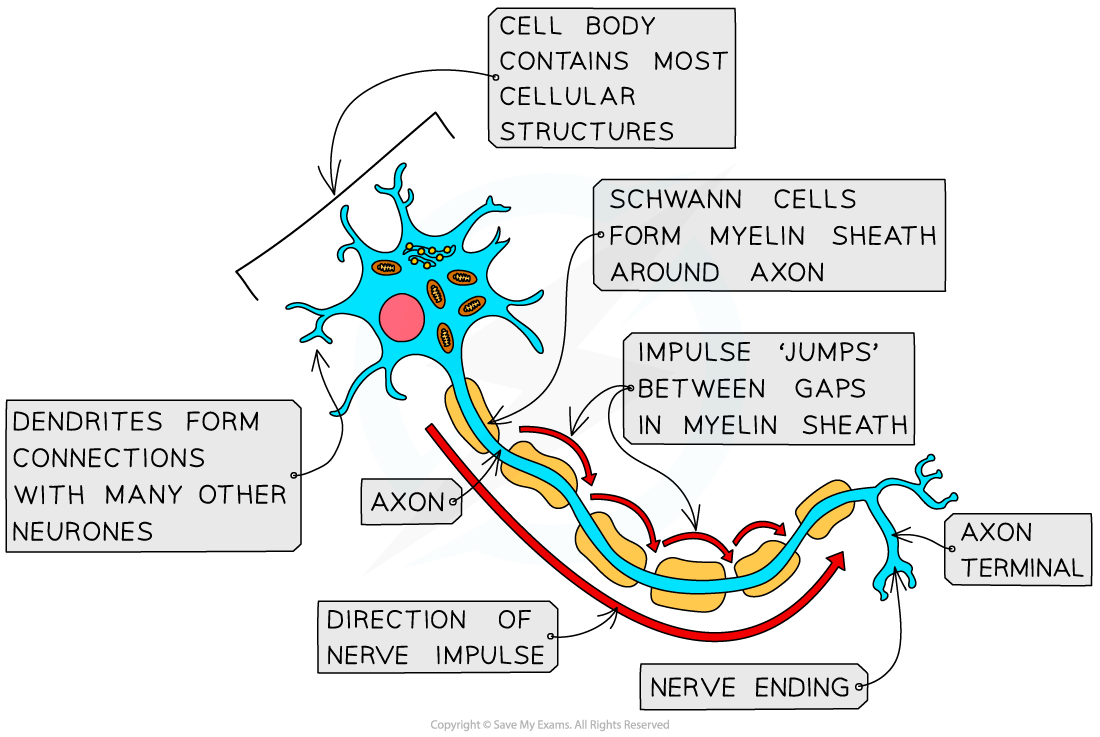
An example of a neurone
-
There are three main types of neurone: sensory, relay and motor
- Sensory neurones carry impulses from receptors to the CNS (brain or spinal cord)
- Intermediate(aka relay) neurones are found entirely within the CNS and connect sensory and motor neurones
- Motor neurones carry impulses from the CNS to effectors (muscles or glands)
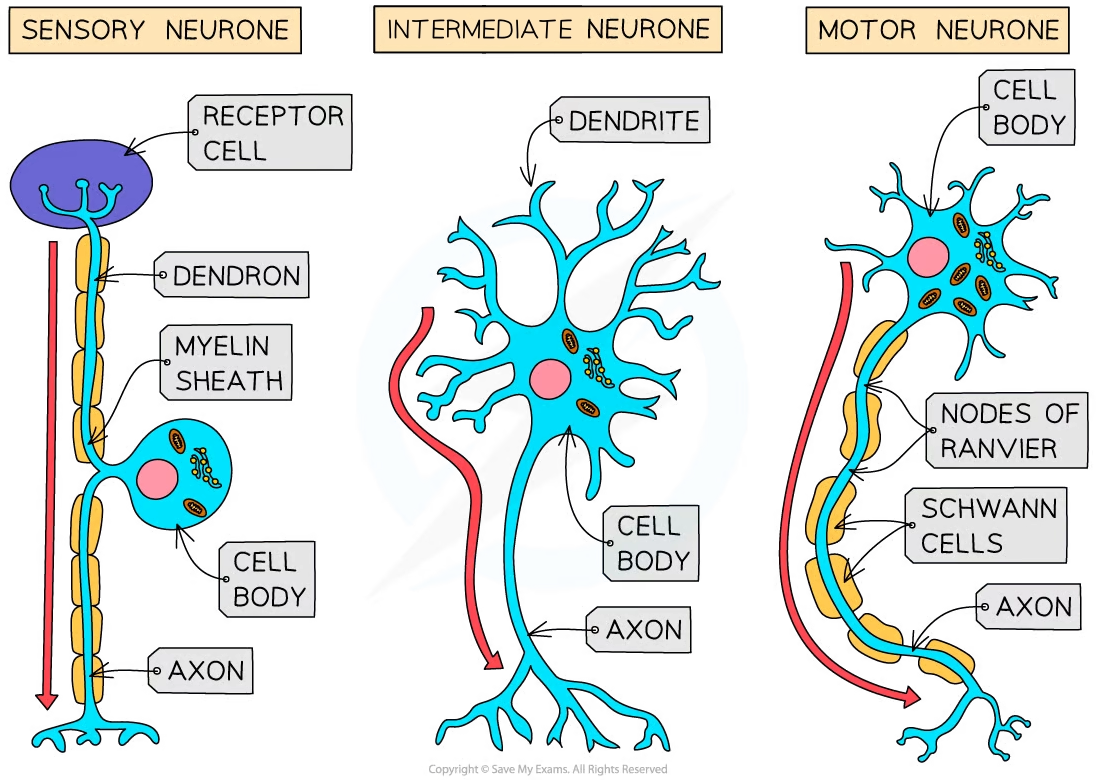
The three types of neurone—the red line shows the direction of impulses. Note that axons always carry nerve impulses away from the cell body
-
Each type of neurone has a slightly different structure
-
Motor neurones have:
- A large cell body at one end, that lies within the spinal cord or brain
- A nucleus that is always in its cell body
- Many highly-branched dendrites extend from the cell body, providing a large surface area for the axon terminals of other neurones
-
Sensory neurones have the same basic structure as motor neurones, but have:
- A cell body that branches off in the middle of the cell - it may be near the source of stimuli or in a swelling of a spinal nerve known as a ganglion
Exam Hint You may be asked to identify the different types of neurone in a diagram. It can be helpful to memorise the key differences between them—such as the location and size of the cell body.
Was this revision note helpful?