Straight-Line Method of Depreciation (Cambridge International A-Level Accounting)
Straight-line depreciation
Spec point — how to calculate depreciation using the reducing balance and straight-line methods
What is the straight-line method of depreciation?
-
The straight-line method of depreciation assumes that a non-current asset loses value at a constant rate over its useful life
-
This means that the expense for its depreciation is the same each year
-
The net book value can reach $0
- This is when the asset is fully depreciated
-
-
You could be given the depreciation rate as a percentage of its original value
- E.g. depreciation could be charged at 20% of its original cost
-
Or you could be expected to calculate the depreciation using:
-
The number of years that the non-current asset will be used
-
The expected value of the non-current asset at the end of its working life
- This value could be $0
- The expected value is also called the residual value
-
-
This method is usually used when the asset will be equally valuable for each year of its use
- For example, fixtures and fittings, equipment, etc
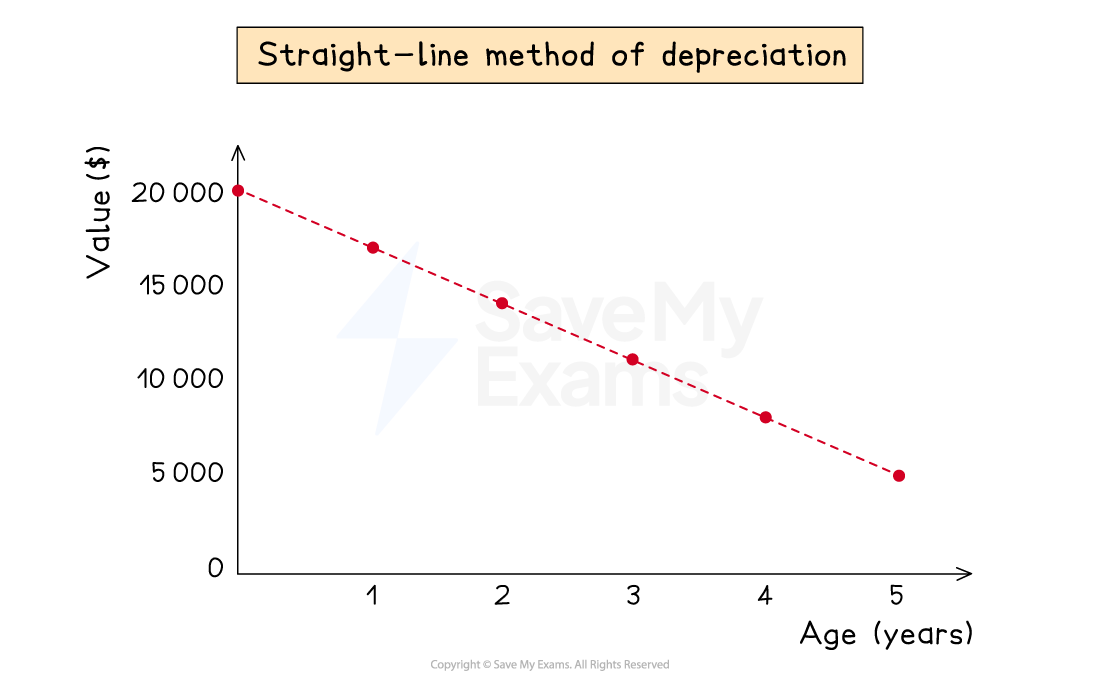
Example of an asset which cost $20 000, being charged depreciation at 15% per annum using the straight-line method
How do I calculate depreciation using the straight-line method?
-
If you are given the percentage for the depreciation
- Find the percentage of the original amount
- This will be the yearly depreciation charge
-
If you are not given the percentage
-
Calculate the expected loss in value during the expected life of the non-current asset
- The original value minus the expected value at the end of its life
-
Divide the loss by the number of years it will be used
-
This will be the yearly depreciation charge
-
Exam Hint The straight-line method is similar to simple interest calculations used in maths.
Worked Example Abi purchases machinery for $18 000. Machinery is depreciated at 15% per annum using the straight-line method.
Calculate the net book value of the machinery after 3 years.
Answer:
- Calculate the yearly expense due to depreciation
15% × $18 000 = $2 700
- Calculate the total depreciation after 3 years
3 × $2 700 = $8 100
- Subtract the depreciation from the original value
$18 000 - $8 100 = $9 900
Worked Example Taiki purchases a vehicle for $30 000. He expects to use the vehicle for 3 years, after which he estimates that it will have a value of $12 000.
Calculate the yearly expense due to the depreciation of the vehicle.
Answer:
- Calculate the loss in value over the 3 years
$30 000 - $12 000 = $18 000
- Divide this by the number of years
$18 000 ÷ 3 =** $6 000**
Was this revision note helpful?