Trade Receivables & Trade Payables Budgets (Cambridge International A-Level Accounting)
Trade receivables budget
Spec point — how to prepare the following budgets: – trade receivables
Trade receivables budget
How to prepare a trade receivables budget?
-
The trade receivable budget shows activities relating to credit customers
-
Activities include:
- Credit sales
- Sales return
- Discount allowed
- Receipts of money received from customers
-
Here is an example of what a trade receivables budget would look like
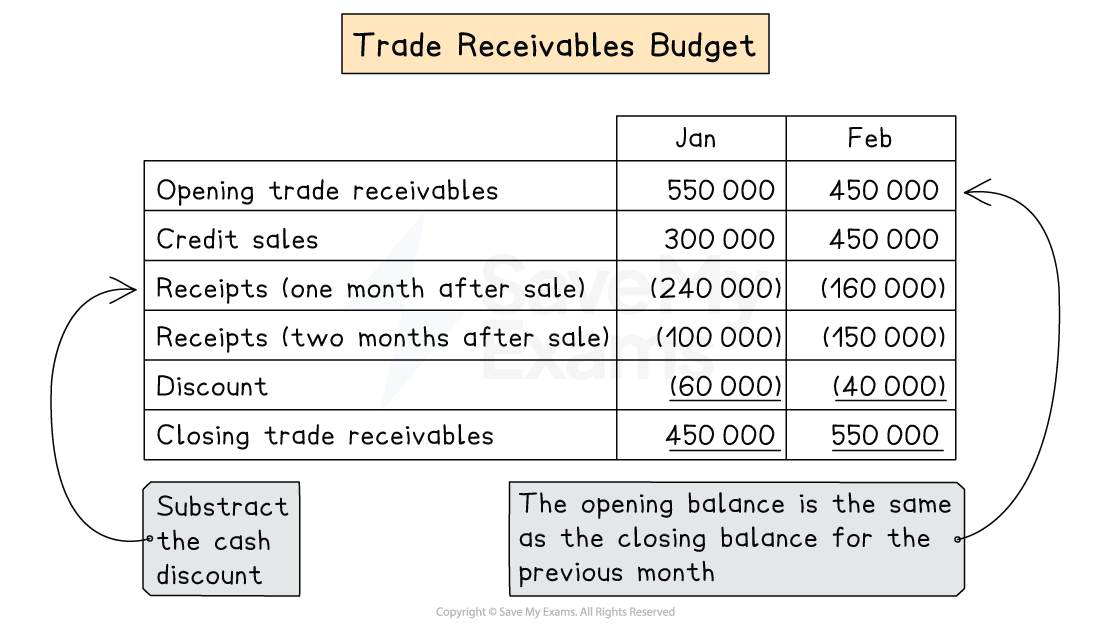
Example of a trade receivables budget
-
STEP 1 Work out the opening balance for the first period by calculating how much the customers owe at the start of the period
-
STEP 2 Find the sales expected on credit for that period
- This might come from a sales budget
-
STEP 3 Calculate the money received from customer
-
Usually a percentage of customers pay in that month or the next month
- These normally get a cash discount
-
The rest usually pay in the following month
-
-
STEP 4 Find any other transactions relating to credit customer, such as:
- Sales return
- Discount allowed
Worked Example Furniture Limited makes and sells a range of furniture. The following information is provided:
Sales budget for Furniture Limited:
November December January February March Units 55 000 62 000 70 000 80 000 75 000 Additional information
- All sales are made on credit basis
- The selling price is fixed at $5
- 30% of customers pay a month after the sale and get a 5% discount
- The remainder of customers will pay two months after the sale
Prepare the trade receivables budget for January, February and March
Answer
- Calculate the opening balance for the first month
January opening balance
November = (55 000 × $5) × 70% = $192 500
December = (62 000 × $5) × 30% = $93 000
$192 500 + $93 000 = $285 500
- Calculate the sales for each month
January sales = 70 000 × $5 = $350 000
February sales = 80 000 × $5 = $400 000
March sales = 75 000 × $5 = $375 000
- Calculate the discount allowed for each month
January = (62 000 × $5 × 30%) × 5% = $4 650
February = (70 000 × $5 × 30%) × 5% = $5 250
March = (80 000 × $5 × 30%) × 5% = $6 000
- Calculate the money received each month
January = (55 000 × $5 × 70%) + (62 000 × $5 × 30% × 95%) = $280 850
February = (62 000 × $5 × 70%) + (70 000 × $5 × 30% × 95%) = $316 750
March = (70 000 × $5 × 70%) + (80 000 × $5 × 30% × 95%) = $359 000
- The answer will be shown as the trade receivable budget:
January
$February
$March
$Balance b/d 285 500 350 000 428 000 Add: Sales 350 000 400 000 375 000 Less: Money received from customer (280 850) (316 750) (359 000) Less: Discount allowed (4 650) (5 250) (6 000) Balance c/d 350 000 428 000 438 000
Trade payables budget
Spec point — how to prepare the following budgets: – trade payables
Trade payables budget
How to prepare a trade payable budget?
-
The trade payable budget shows activities relating to credit supplier
-
Activities include:
- Credit purchases
- Purchase returns
- Discount received
- Payments to credit suppliers
-
Here is an example of what a trade payables budget would look like
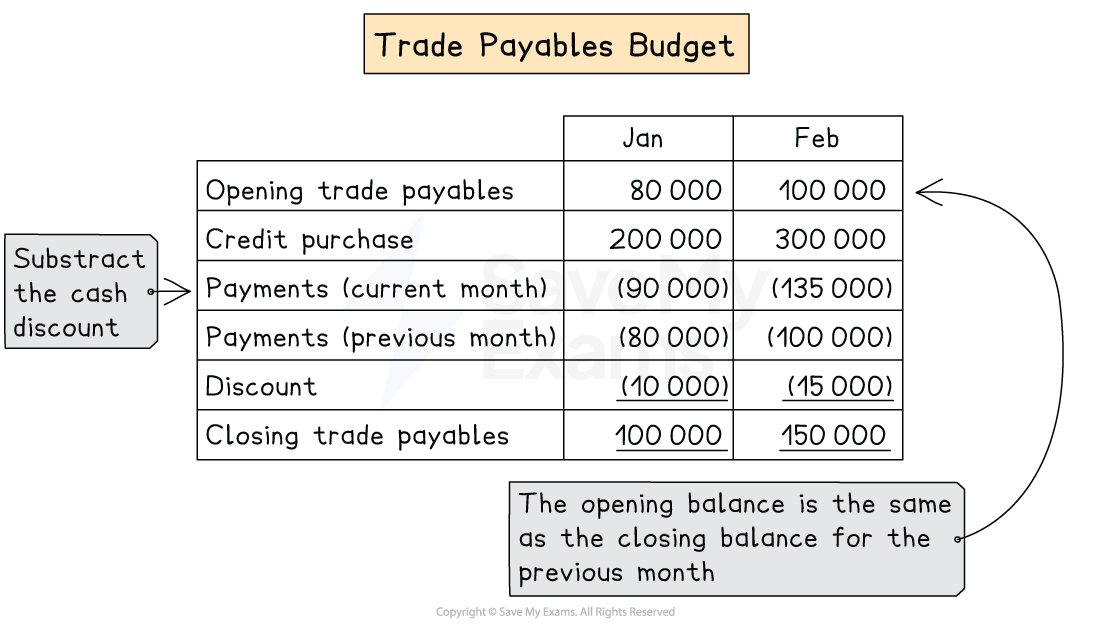
Example of a trade payables budget
-
STEP 1 Work out the opening balance for the first period by calculating how much the business owes the suppliers
-
STEP 2 Find the purchases expected on credit for that period
- This might come from a purchases budget
-
STEP 3 Calculate the money paid to suppliers
-
Usually a percentage of suppliers are paid in that month or the next month
- These normally give a cash discount
-
The rest usually are paid in the following month
-
-
STEP 4 Find any other transactions relating to credit suppliers, such as:
- Purchase return
- Discount received
Worked Example Bottles Limited makes and sells a range of bottles. The following information is provided:
Extract from the production budget for Bottles Limited:
November December January February March Units of production 5 000 6 000 6 400 8 000 7 000 Additional information
- Each unit needs 0.25 kg of material at $8 per kg
- 40% of the suppliers are paid in the month after the purchase and a 5% discount will be received
- The remainder of suppliers will be paid two months after the purchase
- All materials are used up in the same month and no inventory is kept
Prepare the trade payables budget for January, February and March
Answer
- Calculate the cost per unit
0.25 kg × $8 = $2
- Calculate the opening balance for the first month
January opening balance
(5 000 ×$2) × 60% = $6 000
(6 000 × $2) × 40% = $4 800
$6 000 + $4 800 = $10 800
- Calculate the purchases for each month
January purchases = 6 400 × $2 = $12 800
February purchases = 8 000 × $2 = $16 000
March purchases = 7 000 × $2 = $14 000
- Calculate the discount received for each month
January = (6 000 × $2 × 40%) × 5% = $240
February = (6 400 × $2 × 40%) × 5% = $256
March = (8 000 × $2 × 40%) × 5% = $320
- Calculate the money paid each month
January = (5 000 × $2 × 60%) + (6 000 × $2 × 40% × 95%) = $10 560
February = (6 000 × $2 × 60%) + (6 400 × $2 × 40% × 95%) = $12 064
March = (6 400 × $2 × 60%) + (8 000 × $2 × 40% × 95%) = $13 760
- The answer will be shown as the trade payable budget:
January
$February
$March
$Balance b/d 10 800 12 800 16 480 Add: Purchases 12 800 16 000 14 000 Less: Money paid to suppliers (10 560) (12 064) (13 760) Less: Discount received (240) (256) (320) Balance c/d 12 800 16 480 16 400
Was this revision note helpful?
Build on this topic