Goodwill (Cambridge International A-Level Accounting)
Spec point — goodwill and the difference between purchased goodwill and inherent goodwill
Goodwill
What is goodwill?
- Goodwill is an intangible non-current asset
- It has no physical existence
- It cannot be sold separately from the business
Why might a business have goodwill?
-
The following are reasons why a business might have goodwill
- A good reputation, well-known brand and strong image
- Having many loyal customers
- Having good relationships with suppliers
- Being in a good location
- Having experienced and efficient employees
What is the difference between inherent and purchased goodwill?
-
Inherent goodwill is internally generated
- A business gains this naturally over time by their continued efforts
-
Inherent goodwill is not included in the financial statements or maintained in the book of accounts because:
- its valuation is highly subjective as there is not an agreed formula to measure it
- the assets of a business should not be overstated according to the prudence concept
- the factors that create goodwill (like reputation) are difficult to measure in monetary terms
-
Purchased goodwill is gained when a business is purchased or taken over by another business
-
Purchased goodwill is calculated by subtracting the fair value of the net assets from the price paid
-
Purchased goodwill is included in the financial statements and maintained in the book of accounts
Why should I use a goodwill account for inherent goodwill?
-
Use a goodwill account when there is a change in a partnership
- change in the partners' profit-sharing ratio
- introduction of a new partner
- retirement of an existing partner
- dissolution of a partnership
-
The partners' capital accounts are adjusted so that the goodwill account can be immediately written off
-
The value of the goodwill is added to the partners' capital accounts using the old profit-sharing ratio
- These are credit entries to the capital accounts
-
The goodwill is then eliminated by subtracting the value from the partners' capital accounts using the new profit-sharing ratio
- These are debit entries to the capital accounts
-
What is the layout of a goodwill account?
-
Goodwill is raised by making entries on the debit side
- It is shared between the partners' capital accounts using the old ratio
- It is on the debit side as it represents an asset
-
Goodwill is written off by making entries on the credit side
- It is shared between the partners' capital accounts using the new ratio
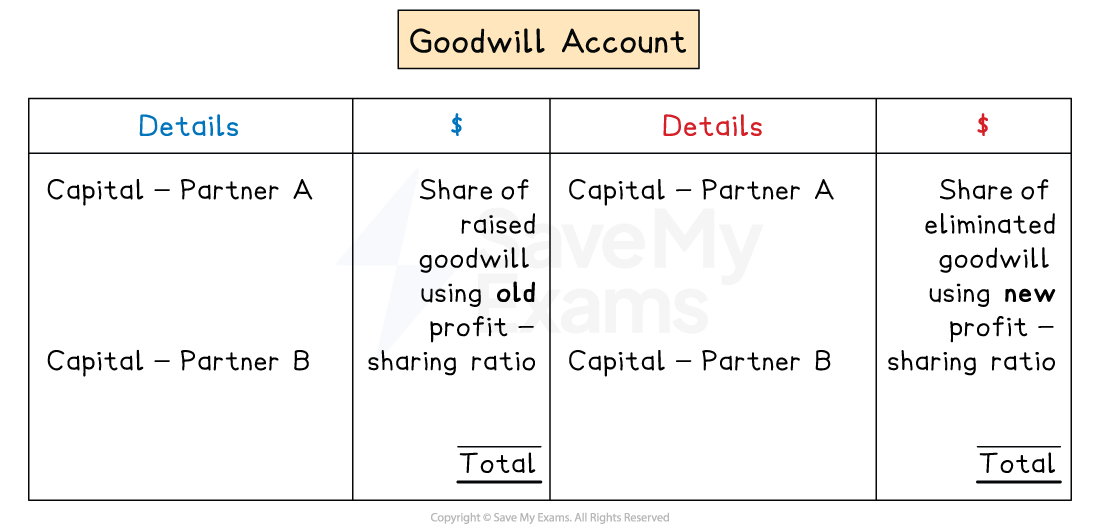
Layout of a goodwill account for inherent goodwill
Exam Hint You will not be asked to prepare a goodwill account for inherent goodwill. However, you can still use one if you find them helpful.
Worked Example Tom and Jerry are in a partnership and they share profits and losses equally.
On 1 January 2026, they changed their partnership agreement so that the profit and loss sharing ratio would be Tom 40% and Jerry 60%.
The balances on the capital accounts at 31 December 2025 were:
$ Tom 40 000 Jerry 50 000 Goodwill was valued at two times the average profits of the last three years.
The profits for the last three years were:
$ 2025 42 000 2024 38 000 2023 31 000 Calculate the capital account balance of each partner at 1 January 2026.
Answer:
Calculate the average profit of the last three years
\frac{\ 42 000 + $ 38 000 + $ 31 000}{3} = $ 37 000$
Find the value of the goodwill
2 \times \ 37 000 = $ 74 000$
Calculate the share of the goodwill using the old ratio
Tom: \ 74 000 \div 2 = $ 37 000$
Jerry: \ 74 000 \div 2 = $ 37 000$
Calculate the share of the goodwill using the new ratio
Tom: \ 74 000 \times 40 % = $ 29 600$
Jerry: \ 74 000 \times 60 % = $ 44 400$
Calculate the new capital balances
- Add the share of goodwill using the old ratio
- Subtract the share of goodwill using the new ratio
Tom
$Jerry
$Balance at 31 December 2025 40 000 50 000 Goodwill 37 000 37 000 Goodwill eliminated (29 600) (44 400) Capital account at 1 January 2026 Final answer: 47 400 Final answer: 42 600
Was this revision note helpful?
Build on this topic