Factory Profit & Unrealised Profit (Cambridge International A-Level Accounting)
Factory profit
Spec point — how to account for manufacturing profit the reasons why a business may account for manufacturing profit
Factory profit
What is factory profit?
-
Factory profit is an additional amount added to the cost of production before the finished goods are transferred to the statement of profit or loss
- Factory profit is also called manufacturing profit
-
It is usually expressed as a percentage mark-up on the cost of production
Why might businesses account for factory profit?
-
Businesses apply a rate of factory profit so that they can compare the transfer value with the sale prices of the same goods offered by competitors
- This is known as benchmarking
- The managers can then decide whether to continue to produce the goods or purchase them from a supplier
-
The manufacturing department can be treated as a separate profit centre and its performance can be evaluated
- Targets can be set for the factory profit
What is the accounting treatment for factory profit?
-
The factory profit is calculated
- Multiply the cost of production by the rate of factory profit
-
Add the factory profit to the cost of production to give the transfer value in the manufacturing account
- This is a debit entry to the manufacturing account
-
The transfer value is then used to calculate the cost of sales and then the gross profit
-
The factory profit is then added to the gross profit
- This essentially eliminates the factory profit from the transfer value
- This ensures that the factory profit does not lower the profit for the year
- This is a credit entry to the statement of profit or loss
Worked Example P Limited is a manufacturing business. It applies a rate of factory profit of 20%.
At 1 January 2025, the finished goods inventory at transfer value was $28 800.
The cost of production for the goods produced during the year ended 31 December 2025 was $314 000.
At 31 December 2025, the finished goods at transfer value was $21 600.
Find the transfer value of the goods produced for the year ended 31 December 2025.
Answer:
Multiply the cost of production by the rate of factory profit to find the factory profit
20% × $314 000 = $62 800
Add this to the cost to find the transfer value
$314 000 + $62 800 = $376 800
Unrealised profit
Spec point — how to account for manufacturing profit and the elimination of unrealised profit from unsold inventory
What is unrealised profit?
-
Unrealised profit is the amount of the factory profit that is included in the valuation of closing inventory of the manufactured goods
-
Goods are transferred to the statement of profit or loss using the transfer value which includes the factory profit
- This profit has not been earned for the goods that remain unsold at the end of the year
What is a provision for unrealised profit?
-
A provision for unrealised profit is used to show the true valuation of the inventory held at the end of the year
- It is very similar to an allowance for irrecoverable debts
-
It complies with the prudence concept by ensuring that the assets are not overstated
-
The balance on the provision for unrealised profit account is the amount of valuation of the closing finished goods that arises due to the rate of factory profit
How do I calculate the balance of the provision for unrealised profit?
-
Use the formula
(Factory profit %)/(100 % + Factory profit %) x Transfer value of the closing finished goods- For example, suppose the rate of factory profit is 25% mark-up on cost and finished goods at transfer value is $20 000
- \frac{25}{125} \times \ 20 000 = $ 4 000$
-
The fractional part of the formula is the factory profit margin
- In the example above, the factory profit margin is
-
The remaining value of the closing finished goods is the cost to produce them
- In the example above, the goods cost \ 20 000 - $ 4 000 = $ 16 000$
-
If you know the balance of the provision, then you can find the transfer value of the finished goods by rearranging the formula
Exam Hint Remember, you use a mark-up percentage to find the transfer value. But if you have the transfer value, you use the margin percentage to find the provision for unrealised profit.
How do I make entries in the provision for unrealised profit account?
-
STEP 1 Calculate the opening balance and enter this on the credit side
- This uses the value of the opening finished goods
- This might be given in the question
-
STEP 2 Calculate the closing balance and enter this on the debit side
- This uses the value of the closing finished goods
-
STEP 3 Calculate the change in the balance of the provision
- It is entered on the credit side if it is an increase
- It is entered on the debit side if it is a decrease
- The other side of the transaction is entered in the statement of profit or loss
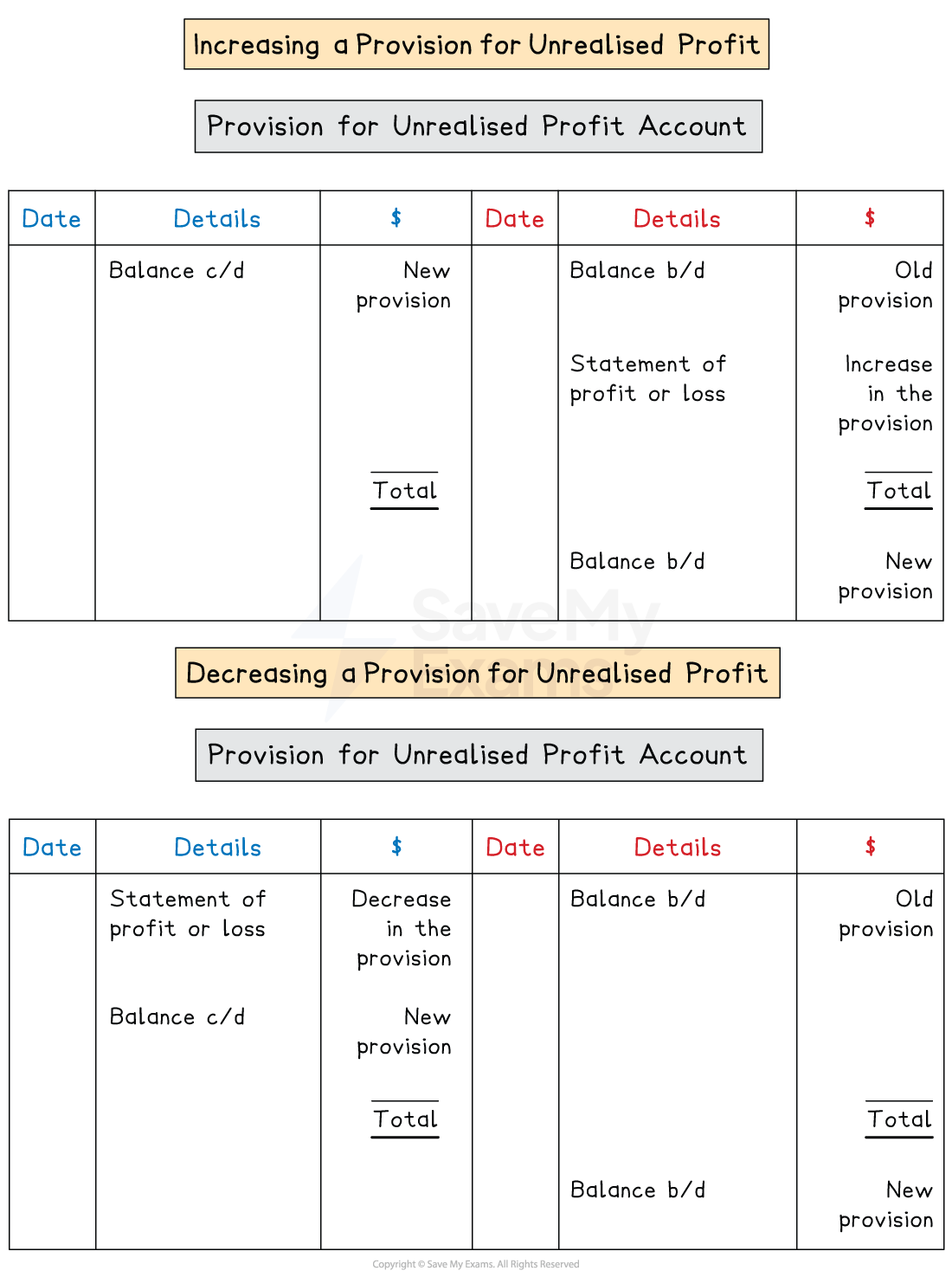
Layout of the provision for unrealised profit account
Worked Example P Limited is a manufacturing business. It applies a rate of factory profit of 20%.
At 1 January 2025, the finished goods inventory at transfer value was $28 800.
The cost of production for the goods produced during the year ended 31 December 2025 was $314 000.
At 31 December 2025, the finished goods at transfer value was $21 600.
Prepare the provision for unrealised profit account for the year ended 31 December 2025.
Answer:
Calculate the opening balance of the provision for unrealised profit
\frac{20}{120} \times \ 28 800 = $ 4 800$
Calculate the closing balance of the provision for unrealised profit
\frac{20}{120} \times \ 21 600 = $ 3 600$
Calculate the decrease
\ 4 800 - $ 3 600 = $ 1 200$
Provision for unrealised profit account
$ $ Statement of profit or loss 1 200 Balance b/d 4 800 Balance c/d 3 600 4 800 4 800 Balance b/d 3 600
Was this revision note helpful?